Building Triple Deckers in Providence — A Tale of Dimensions, Parking Minimums, and Zoning Variances
The process of building new housing in Providence is guided by zoning regulations, which dictate the aspects of a new building from lot dimension requirements to parking space minimums per unit. Unsurprisingly, these rules can fly under the radar of lay people.
Those interested in the housing development process pay close attention to the actions of the City Plan Commission (CPC). While it has the authority to grant relief from zoning regulations in the form of variances, it is the original regulations that have great influence on the shape of new projects.
To follow an undeveloped piece of land in Providence through the process of building a three-story, three-unit dwelling, there’s a gauntlet of zoning, planning, and review within the current standards. The requirements are contained in the City of Providence Zoning Ordinance (PDF) (PZO) which was enacted in 2014 but which is updated continuously — the latest update was added in March of 2025.
#A brief historical context of triple decker houses in Providence
According to public historian, Traci Picard, triple decker housing in Providence became popular at the turn of the century, as the “late 1800s saw the start of the building boom,” with 1900-1910 being the housing type’s peak.
Beyond their efficiency in creating multiple housing units within a single lot, triple deckers represent the history of Providence’s “overall impact of immigration, labor, and technology at the same moment,” Picard continues.
“[The triple decker] allowed one person or family to buy a home, and use the apartments to help pay the mortgage. It also enabled intergenerational family living and chosen family community-building. Essentially, the triple-decker allowed for small-scale mutual aid: help with children, an extra ear out for trouble, the sharing of gossip, a cup of milk or any kind of care.”
Despite these benefits, Picard notes that triple-deckers were “generally considered lower class, and became entangled with complicated feelings around immigration, Catholicism, and ‘outsiders.’”
“It seems like this eased off for a bit, but the triple-deckers and tenements were repeatedly a target for ‘redevelopment,’ and many were knocked down beginning c. 1940s.”
#Developing three-family homes today
#Step 1: Determine which Zoning District the land is within
It is not enough to find a piece of undeveloped land within the city bounds. The land must be within a zoning district that permits residential use and allows the desired project size.
R-1A and R-1 Districts only allow low density, single family homes (reference Article 4 in the PZO). R-1A requires a minimum lot size of 7,500 square feet for newly created lots while the R-1 zone requires only 5,000 square feet, favoring slightly higher density. These zones restrict building height to three stories and only one principal building per lot.
R-2 zones have been removed by the 2014 ordinance. That does not mean that medium-density R-2 zones do not exist, only that new R-2 zones will not be created.
R-3 and R-4 zones are what a three-unit dwelling requires. R-3 zones allow one-, two-, or three-unit dwellings and are intended to provide a transition between low and high density areas. Lots need to be a minimum 5,000 square feet with no dimension along its exterior less than 50 feet.
The R-4 zone is the most permissive and allows four or more residential units on the same lot. The City Plan Commission favors increasing density in these zones, as the updated Comprehensive Plan proposes to increase the footprint of R-3 and R-4 zones throughout the City. As a result, more and more existing R-2 zones are being converted to R-3.
A zoning amendment made in June of 2022 removed the minimum lot area per dwelling unit calculation in R-4 zones. An arbitrary ratio of land area per unit was the means to determine how many units the lot could support. The maximum number of units is no longer restricted by the dimensions of the lot or constraints like setbacks and height, it is instead restricted by the building code’s minimum size for dwelling units and other design constraints for circulation, structure, and building systems — which means someone can’t build a unit that fails to meet building codes. This move further promotes density increases in R-4 zones.
#Step 2: Understand zoning dimensional requirements
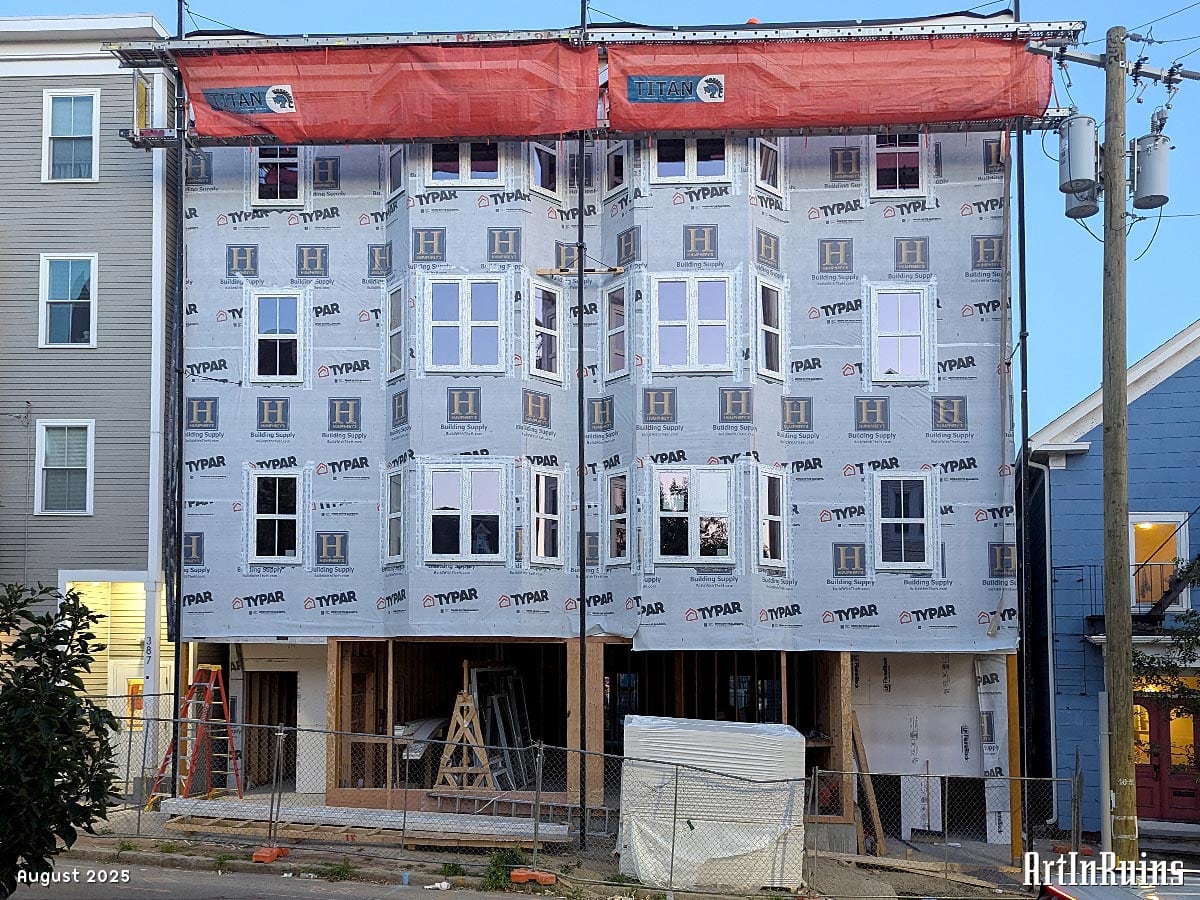
Zoning rules dictate the maximum allowed building size a lot will support. Regulations include minimums for lot size and width, how much of the lot can be occupied by a structure, a maximum height, and required setbacks from property lines (a setback is the distance between the lot line and the wall of a dwelling).
The zone determines these dimensional restrictions. R-3 zones have well-defined standards that restrict new construction to a 45% maximum building coverage on the lot. That means a 5,000 square foot lot can support a building with a maximum 2,250 square foot footprint, or roughly a 36 x 62 foot area. A maximum height of 45 feet (three stories) is allowed — but, if an existing lot is less than 2,500 square feet, the height limit is 32 feet (two stories).
A R-4 zone supports many of the same dimensions, but is allowed to have a smaller minimum area for new construction. Lots need to be a minimum of 3,500 square feet with no dimension less than 35 feet. The maximum building coverage on the lot increases to 55% (1.925 sf on a 3,500 sf lot) and the maximum building height is also 45 feet.
Both the R-3 and R-4 zones have “front setbacks” — where the building meets the street — that is regulated by a “build-to zone” calculation. This calculation takes into account the average existing front setbacks for dwellings within 100 feet so as to maintain the existing neighborhood character at the sidewalk.
#Step 3: Understand when to ask for a variance
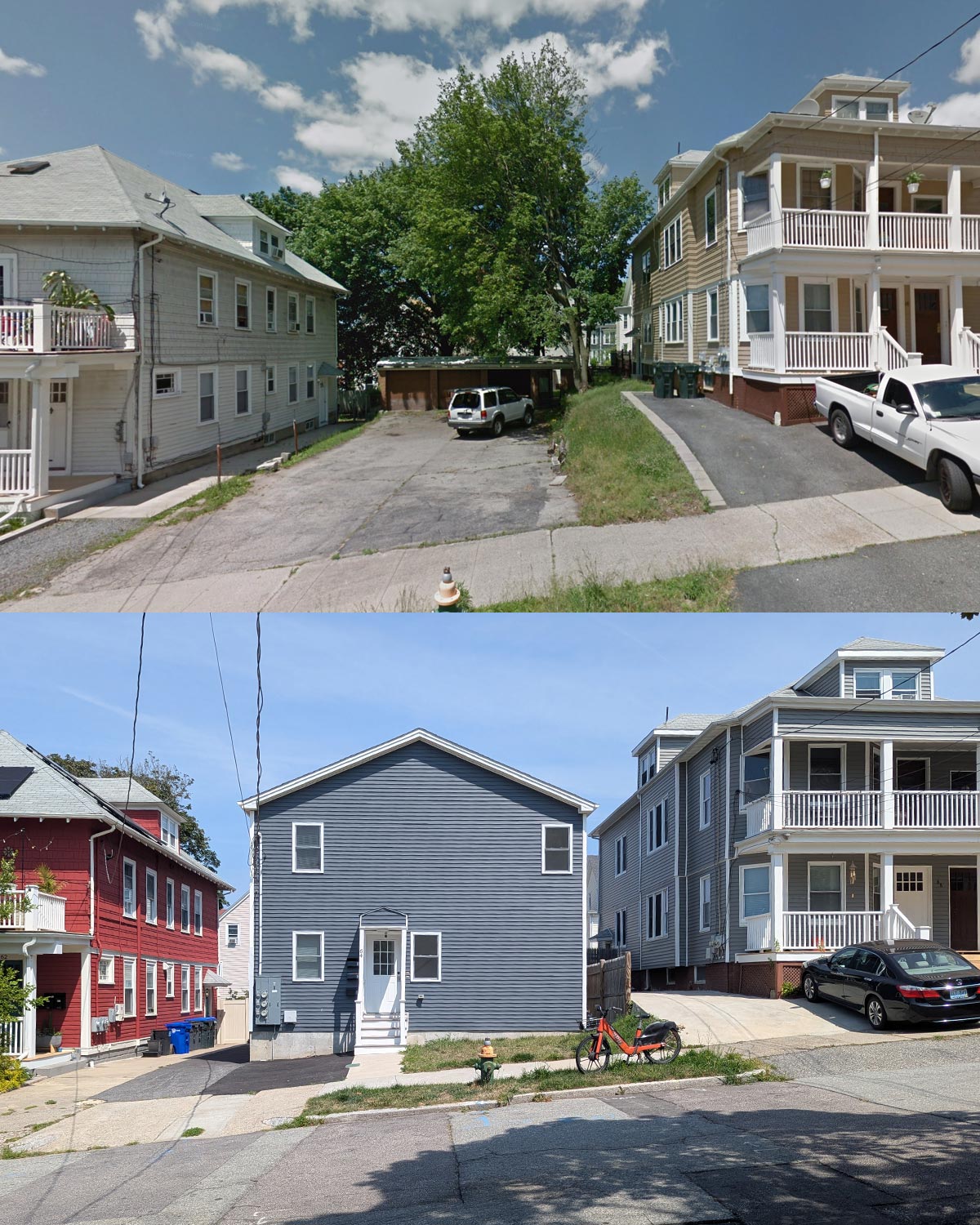
The zoning rules are a starting point for any project. But some lot sizes and dimensions would be impossible to develop if the zoning rules were inflexible. This is where the CPC can use its discretion to grant a subdivision variance to allow a project to move forward.
A recent example of this was a proposed subdivision at 56 Bridgham Street in South Providence in an R-3 zone (CPC staff report PDF). The proposed new lot was only 40 feet in width while the R-3 zone requires 50 feet. The neighborhood already had many existing lots that did not conform to modern zoning standards. The CPC granted a dimensional variance in order to gain a new three-family dwelling in this medium-density neighborhood.
Most developers use the zoning rules as a guide. From there, to meet cost ratios and other metrics, they determine which zoning rules would require a variance to make the project more feasible. If the developer is smart and they align the goals of the project with the broader goals of the City and its Comprehensive Plan, they are likely to get approval for the variances their project requires.
#Step 4: Understand parking requirements
Parking used to be one of the more restrictive zoning ordinances that greatly shaped land development in the early 2000s into the mid-2010s. Providence was progressive in 2014 when they required only one parking space per dwelling unit, and the Comprehensive Plan update wants to go further.
The Comprehensive Plan explicitly states a goal to “Reduce or Eliminate off-street parking requirements citywide.” Parking is seen as detrimental to efficient land use — more dwelling units can be built if parking minimums are reduced or removed.
A number of zoning districts have eliminated parking minimums: Residential use in the Downtown D-1 zone, residential in a “Transit-Oriented Development Overlay District,” and development on “Small Lots,” defined as lots less than 10,000 square feet within the R-4 residential zone.
This “Small Lot” exemption is why many of the recent housing developments have included some parking, but not the 2 spaces per apartment requirement that used to dictate land use.
#Step 5: Packaging the proposal and submitting it to the Planning Department
A project like this fictional 3-story, 3-unit dwelling is subject to the design standards for the type of special district it was sited within. The standard R3 or R4 zones have little design oversight — the dimensional restrictions previously mentioned along with building and fire codes already dictate much of the building’s envelope and interior spaces.
The exterior design of the triple decker would be subject to a public meeting only if it were located in a designated special zone — the Downtown District, the Waterfront District, or one of the special purpose Historic Overlay Districts. Design within these zones requires review of the City Plan Commission or the Historic District Commission.
If the project is reviewed during a CPC meeting, that is when the public gets a glimpse of how a neighborhood is evolving. Both public comment and the perspectives of the CPC board will continue to shape a project.
#A Complex but Necessary Process
This fictitious project might take as little as 12 months to move through the planning, design, and approval processes. Developments within a Historic District will require more time to meet design approval. And still, some larger projects will take up to three years to achieve approval.
While much attention is focused on the actions of the CPC, zoning regulations have a much larger effect on development plans before they ever come to the CPC. The Comprehensive Plan is not just a guideline for members of the CPC in their decision making, but it also shapes ongoing amendments to zoning regulations that have a far greater effect on the built environment.
To determine the zone for any piece of land: Providence GIS Hub uses an online map or refer to Overlay Zoning Map PDFs from the Planning Department. Alternatively, HousingWorks RI has a wonderful state-wide Zoning Atlas tool.
A version of this article appeared in the Providence Eye, 27 August 2025, with input and edits by Debbie Shimberg and Ian Baldwin.