Fountain Street, #471
also known as Fountain Service Luncheonette
Three-generations of neighborhood short-order cooks made this tiny place a home for regulars over the course of 50 years
images of this Property
-

2005 — Photo by Jef Nickerson -
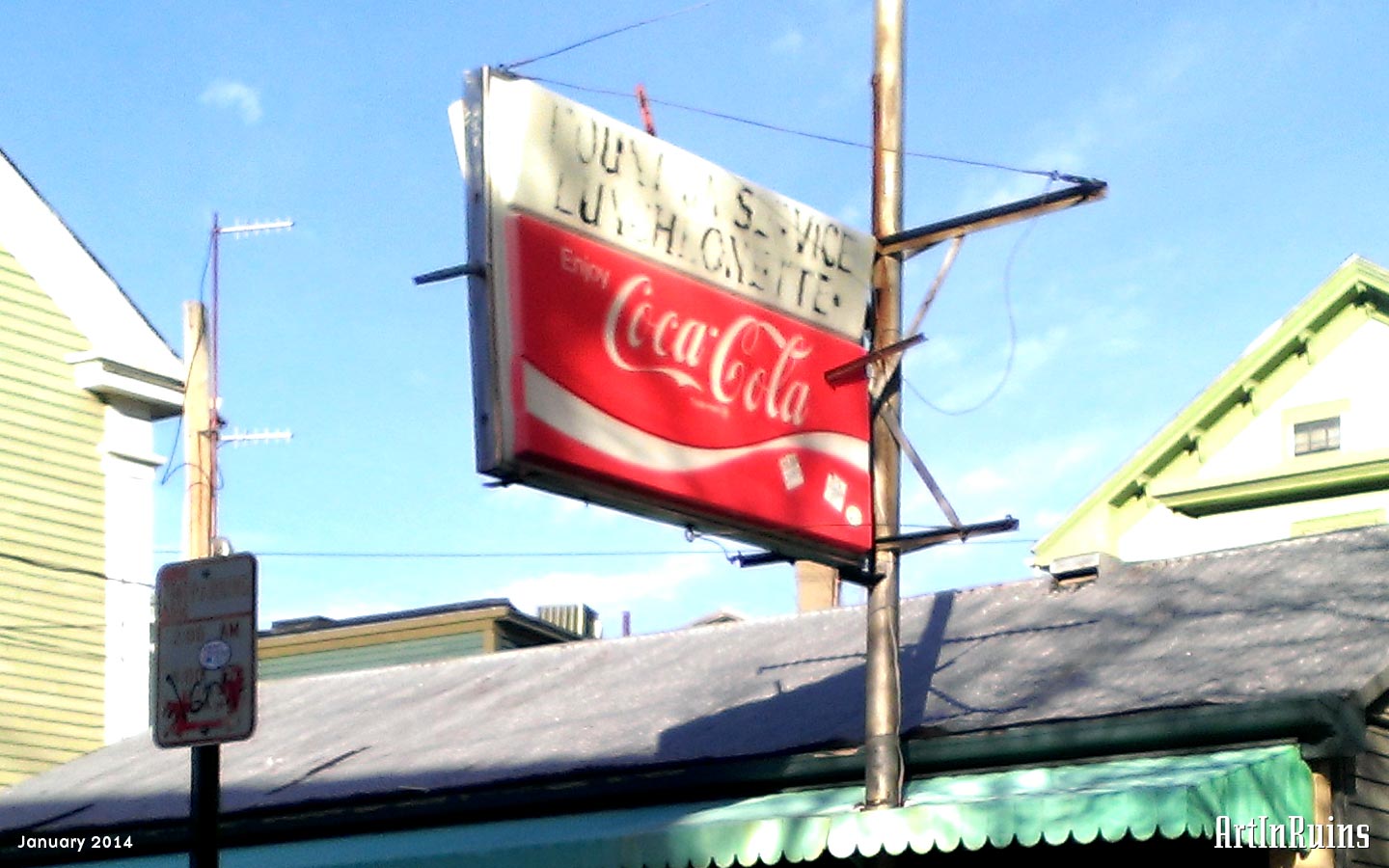
Detail of the plastic Coca-Cola sign reading “Fountain Service Luncheonette” -

-

-
![]()
Detail of the former ice cream flavor sign, reading “Ice Cream Cones and Cabinets; Coffee, Chocolate, Strawberry, Vanilla” -
![]()


6 images: Press to view larger or scroll sideways to see more. Contribution by Jef Nickerson
About this Property
Redevelopment
The address first appears in a 1903 Evening Bulletin article in a notice about recent thefts: “M.J. Donahue, who has a carpenter shop […] has missed a number of tools that are useful to him in his business.”1 In 1918, a similar article about larceny appeared, but this time, Michael J. Donahue and a neighbor held the man until police arrived.2
The long news article captured below says that Johnny “Fat” Lombardi opened the Spa in 1954.
In a 1963 obituary, Aristide Lombardi of 202 Carpenter Street (the adjacent address to the north) was noted as the operator of the Fountain Spa on Fountain Street. He was 75 years old at the time of his passing. It mentions he worked as a bartender and also in “various textile mills” until his retirement in 1952.3 Since the last names are the same, we assume Johnny took over the spa from his father.
Starting in 1976, the address and “Fountain Spa” were listed as a location to buy lottery tickets.4
In March of 1995, a new business was listed as opening with the following details: “Fountain Spa: P: Jean M. Major, 471 West Fountain St., Providence. A: Same. Operate a restaurant.”5 Shortly after, in September, in an obituary it was noted that Frederick Rocco was a short-order cook at the Fountain Spa Bar & Grill in Providence for 25 years before passing away at age 73.6
In 2018, Johnny “Fat” Lombardi, also a Marine Corps. veteran from WWII, passed away at the age of 92.7
Bucktown opened at this location in 2016 offering buckets of fried chicken and fish along with po’boys and burgers. It was even selected as one of the 50 best new restaurants in America by Bon Appetit, but sadly, it could not survive after the pandemic and it closed in 2022.8
Current Events
Restaurant There There opened in 2023 for sandwich pickups and was named to the annual best list of Eater for their decadent burger.
History
From the “Broadway-Armory Historic District” National Register nomination form, 1974
Commercial Building (early to mid-20th C.): 1-story; flank-gable; vertical board and clapboard commercial building. (Non-Contributing)
Maps
- 1920 Sanborn Insurance Map, Volume 1, Plate 45 (page 60) — 471 Fountain Street is a carport for the house along 212 Carpenter Street; yellow, indicating wood framing. According to the Broadway-Armory Historic District, the contributing two-story house at 212 Carpenter was built circa 1855. The news article below mentions that the building “was once a three car garage” which we are not sure was true. This shape of this structure is smaller than the one that comes after it, so it was purpose built at the time. By the 1951 map it is already listed with an “S” for store.
- 1937 G.M. Hopkins Insurance Map, Plate 8 — 1926 still the same as 1920
- 1920–1951 Sanborn Insurance Map, Volume 1, Plate 45 (page 62) — 471 Fountain Street is now a small light blue rectangular, single-story structure (indicating concrete or cinder block) labeled “S” for store. The addition is pasted on top of the previous map without a plot dividing line, so it is possible that the lot was never split into two plats.
In the News
An order of salty banter with every meal
by Chris Hatfield
Providence Journal | December 19, 2006 (abridged)
Editor’s note: Students in an advanced feature writing class at Brown University were assigned to write a feature story about a street that conveys a sense of place. The project, in its eighth year, presents aspects of city life from the perspective of college journalism students.
The building at 471 West Fountain St. looks like it fell out of the sky and landed in the middle of a block of three-story houses. It was once used as a three-car garage and seems to be better suited to serve as a tool shed than a place of business.
The faded facade, metal shingles and rainbow-painted awning give it the ambiance of an old boardwalk snack shack.
At 5 a.m., Ray Major, 60, climbs out of his car, walks to the door of the Fountain Spa and goes inside. He takes the stools off the countertops. He switches the dim lights on, puts copies of the newspaper on a shelf behind the counter and gets the coffee brewing.
From now until the early afternoon, the cars that line up outside will be the only hints that there is life inside.
The windows are hidden by the awning, blocking the light from inside. The signs offering hot coffee and sandwiches outside the shack are from another age. They offer ice cream cones, cabinets and fountain service, but the soda fountain from which the place gets its name and ice cream have long since been removed from the menu.
By 6 a.m., the seven or eight morning regulars arrive. Their expletive-laden chatter jumps at the entering customers as quickly as the smell of coffee and eggs does. The customers mostly direct their barbs at Major, who dutifully makes their breakfast, gets their scratch tickets and checks their Keno receipts.
“Hey. … Can I get another?” yells Fred Rozen, 57, after winning back his $2 on a scratch ticket.
“That’s mister!” another customer corrects him.
“Hey, Mister …! Can I get another?” Rozen hollers in response, drawing a chuckle from Major and the crew.
Major has run the Fountain Spa for 10 years. He took over after his father-in-law, Johnny “Fat” Lombardi, retired, although both men’s names are on the spa’s business card. Lombardi, a carpenter by trade, turned the garage into a place of business in 1954. Other than an addition in 1963, it looks more or less the same as it did when he opened.
The Fountain Spa got its name from the soda fountain that was popular when the spa first opened. “Spa” was an old regional name for a place that had a soft drink and ice cream dispensing fountain. Occasionally someone unfamiliar with the term will call the place to make an appointment for a facial.
Here, the fountain was removed long ago, as the modest space could not hold the number of customers that wanted to come in. “The line used to be around the corner from 11 to 1,” says Chet Manna, a regular since the spa opened 52 years ago.
At the height of the Fountain Spa’s popularity, when the surrounding houses were filled with families rather than Johnson & Wales University students, customers had to take a number at the door and wait their turn to get in. The local families would run tabs and pay weekly.
Manna, 86, remembers how different life was in the Federal Hill neighborhood when the spa opened.
“It’s like every other [city] neighborhood,” he says. “Those days you could leave your door open. You knew everyone in your neighborhood for 40 years, 30 years. Today you don’t even know your upstairs tenant!”
Back then, when the spa was more commonly called Johnny Fat’s, Lombardi kept the door open from 5 a.m. to 11 p.m. and served breakfast, lunch and dinner. He’d planned it as a side business to carpentry. But the diner’s popularity forced him to give up the other work.
“Would I do it again? Never!” Lombardi says in his measured tempo. “If I’d stayed with the hammer, I woulda been rich. These guys get two-hundred fifty dollars to put in a door [now]. I was making 32 dollars a week!”
Over the years, the pinball machines and soda fountain were replaced by a video screen for Keno and a lottery machine. But the same pale yellow countertops and red tile on the floor remain from the spa’s opening. The same old menu boards with the Coca-Cola logo and the same dark yellow walls you’d find in the kitchen of your great aunt’s house are the backdrop for your meal. When you order a soda, you get some of it in a glass with ice along with the rest still in its can.
The saltiness of the banter ebbs as the morning progresses, but the relaxed, wisecracking attitude remains. Rozen stalks back and forth in the narrow dining area, trying to find Major’s coffee and steal it. Clusters of customers break off into side conversations about one man’s purchase of a new Harley-Davidson or another’s decision to drop out of high school many moons ago. The newspaper is passed around.
“Hey, look at Ray’s house, they’re knocking it down,” cracks Fred Matarese, 49, pointing to a picture of a collapsed house in the national news section.
Matarese is one of the Fountain Spa’s few daily customers who still work on West Fountain Street. He stops by for breakfast every morning before opening Matarese Towing, located about a block east of the spa, at 7 a.m. A small advertisement for his business sits on the erase board behind the counter. It seems out of place, but it was strategically located to be in the background behind Major when Showtime filmed a scene for The Brotherhood in the spa last summer.
The customers here are their own brotherhood. If someone fails to show, he gets a phone call. When Eddie Logan, a regular for 40 years, doesn’t come in one morning because of eye surgery, Major answers questions about his whereabouts throughout the morning.
Matarese, a 30-year customer, says that he received a call a few years ago when he missed a few breakfasts at the spa. One search for Doug “Harry” Rezendes, 63, after he had been missing for a week revealed that his apartment had burned down.
“I don’t like none of these people, but, y’know, they pay, so I gotta make sure they come back,” Major says, drawing laughs.
“But you never checked on me!” one of his customers protests.
“You, I don’t care about!“” Major quickly replies, eliciting even louder laughter.
That atmosphere — camaraderie blended with constant playful digs — manifests itself in the decor. A plaque Rezendes made for Major — the Golden Spatula award, complete with the spray-painted utensil — hangs above the grill to honor the grillmaster’s skill. Another plaque hangs behind the register, honoring the Fountain Spa with a half-star rating.
“[Major] will get a full star in another two years,” Matarese says.
Everyone who walks through the door on a typical weekday morning has been a spa regular for at least 10 years. Major — “the lifeblood of the place,” says Kathy Ursini, one of the regulars — estimates that he has memorized the orders of 95 percent of the clientele. Major slides Ursini’s coffee roll and Italian toast in front of her without asking what she wants.
Manna gets his English muffin with jelly minutes after he saunters over to the counter.
When he’s not pretending to be upset that someone came in, Major greets customers with his big gap-toothed smile. His handshake betrays his former life as a construction worker. His broad forearms taper down to thick mitts.
He began working at the spa about 20 years ago. After spending his working life outside, it had never been his plan to commit long-term to cooking for people, but he wound up taking over the place anyway. To feed his need to do outdoor work, he spends a four-week summer vacation every year working with a cement company.
And it’s not like Major stays with his regular day job for the money. While there’s a strongly loyal clientele, business tends to dry up after the holidays. Typically Major makes only enough to pay bills and “make a decent living.” Although he’s approaching retirement age, Major has no plans to close the spa or even cut his 75-hour work week. He gets help once a week from his wife, Jean, and four days a week from Lombardi. But Major is the one who opens every morning at 5 and closes up whenever the place empties around 2 p.m., give or take an hour.
“These guys [keep me in it],” he says, referring to his customers. “I make a good pay, or a decent pay anyway, and it’s fun to come to work. You could say, ‘Wait, you could go make more money.’ Maybe I can, but it’s fun to come to work.”
The customers talk about anything, the liveliest days of conversation coming when the Red Sox and Yankees play. Any subject is fair game — except politics.
“It gets more carried away than [talking about] sports,” Major explains. “People will say things when they talk about politics and not apologize after.”
— HATFIELD, CHRIS. “TASTE OF PROVIDENCE - An order of salty banter with every meal.” Providence Journal (RI), Metro ed., sec. News, 19 Dec. 2006, pp. D-01. NewsBank: America’s News – Historical and Current, https://infoweb.newsbank.com/apps/news/openurl?ctx_ver=z39.88-2004&rft_id=info%3Asid/infoweb.newsbank.com&svc_dat=AMNEWS&req_dat=D4BD6B42F1AB4706B5E1244D477DEE03&rft_val_format=info%3Aofi/fmt%3Akev%3Amtx%3Actx&rft_dat=document_id%3Anews/152427D6A5D5DE08. Accessed 25 Apr. 2026.
-
Evening Bulletin, 13 Mar. 1903, p. 19. NewsBank: America’s News – Historical and Current, https://infoweb.newsbank.com/apps/news/openurl?ctx_ver=z39.88-2004&rft_id=info%3Asid/infoweb.newsbank.com&svc_dat=AMNEWS&req_dat=D4BD6B42F1AB4706B5E1244D477DEE03&rft_val_format=info%3Aofi/fmt%3Akev%3Amtx%3Actx&rft_dat=document_id%3Aimage%252Fv2%253A147288B4AE4904D8%2540EANX-17429CEF1C3813C5%25402416187-17409C44988AD8E3%254018-17409C44988AD8E3%2540. Accessed 25 Apr. 2026. ↩
-
Providence Journal, 25 Apr. 1918, p. 4. NewsBank: America’s News – Historical and Current, https://infoweb.newsbank.com/apps/news/openurl?ctx_ver=z39.88-2004&rft_id=info%3Asid/infoweb.newsbank.com&svc_dat=AMNEWS&req_dat=D4BD6B42F1AB4706B5E1244D477DEE03&rft_val_format=info%3Aofi/fmt%3Akev%3Amtx%3Actx&rft_dat=document_id%3Aimage%252Fv2%253A14728889532D3B69%2540EANX-162D7F028CCC156C%25402421709-162C3FAC59CC330D%25403-162C3FAC59CC330D%2540. Accessed 25 Apr. 2026. ↩
-
Evening Bulletin, Metropolitan ed., 17 Apr. 1963, p. 6. NewsBank: America’s News – Historical and Current, https://infoweb.newsbank.com/apps/news/openurl?ctx_ver=z39.88-2004&rft_id=info%3Asid/infoweb.newsbank.com&svc_dat=AMNEWS&req_dat=D4BD6B42F1AB4706B5E1244D477DEE03&rft_val_format=info%3Aofi/fmt%3Akev%3Amtx%3Actx&rft_dat=document_id%3Aimage%252Fv2%253A147288B4AE4904D8%2540EANX-174540F391B0DB21%25402438137-17433E298F0672AB%25405-17433E298F0672AB%2540. Accessed 25 Apr. 2026. ↩
-
Evening Bulletin, 9 June 1976, p. 31. NewsBank: America’s News – Historical and Current, https://infoweb.newsbank.com/apps/news/openurl?ctx_ver=z39.88-2004&rft_id=info%3Asid/infoweb.newsbank.com&svc_dat=AMNEWS&req_dat=D4BD6B42F1AB4706B5E1244D477DEE03&rft_val_format=info%3Aofi/fmt%3Akev%3Amtx%3Actx&rft_dat=document_id%3Aimage%252Fv2%253A147288B4AE4904D8%2540EANX-1746995AADEDF0B1%25402442939-1744EAC5443B6B60%254030-1744EAC5443B6B60%2540. Accessed 25 Apr. 2026. ↩
-
“New businesses.” Providence Journal (RI), ALL ed., sec. BUSINESS, 2 Mar. 1995, pp. B-02. NewsBank: America’s News – Historical and Current, https://infoweb.newsbank.com/apps/news/openurl?ctx_ver=z39.88-2004&rft_id=info%3Asid/infoweb.newsbank.com&svc_dat=AMNEWS&req_dat=D4BD6B42F1AB4706B5E1244D477DEE03&rft_val_format=info%3Aofi/fmt%3Akev%3Amtx%3Actx&rft_dat=document_id%3Anews/152521E457E64D28. Accessed 25 Apr. 2026. ↩
-
“North Providence FREDERICK P. ROCCO.” Providence Journal (RI), ALL ed., sec. NEWS, 7 Sept. 1995, pp. C-08. NewsBank: America’s News – Historical and Current, https://infoweb.newsbank.com/apps/news/openurl?ctx_ver=z39.88-2004&rft_id=info%3Asid/infoweb.newsbank.com&svc_dat=AMNEWS&req_dat=D4BD6B42F1AB4706B5E1244D477DEE03&rft_val_format=info%3Aofi/fmt%3Akev%3Amtx%3Actx&rft_dat=document_id%3Anews/15260BFA718F1E58. Accessed 25 Apr. 2026. ↩
-
Providence Journal (RI), 21 Jan. 2018, p. 25. NewsBank: America’s News – Historical and Current, https://infoweb.newsbank.com/apps/news/openurl?ctx_ver=z39.88-2004&rft_id=info%3Asid/infoweb.newsbank.com&svc_dat=AMNEWS&req_dat=D4BD6B42F1AB4706B5E1244D477DEE03&rft_val_format=info%3Aofi/fmt%3Akev%3Amtx%3Actx&rft_dat=document_id%3Aimage%252Fv2%253A1652098DCED03C80%2540AWNB-1699175E56B63BCA%25402458140-1699176E66BD91FB%254024-1699176E66BD91FB%2540. Accessed 25 Apr. 2026. ↩
-
Ciampa, Gail. “A local favorite, Bucktown fried chicken closes after a six-year run in Providence.” Providence Journal: Web Edition Articles (RI), sec. Entertainment, 29 Aug. 2022. NewsBank: America’s News – Historical and Current, https://infoweb.newsbank.com/apps/news/openurl?ctx_ver=z39.88-2004&rft_id=info%3Asid/infoweb.newsbank.com&svc_dat=AMNEWS&req_dat=D4BD6B42F1AB4706B5E1244D477DEE03&rft_val_format=info%3Aofi/fmt%3Akev%3Amtx%3Actx&rft_dat=document_id%3Anews/18C3565FF526AC98. Accessed 25 Apr. 2026. ↩