Hanley Building
A handsome, turn-of-the century commercial investment property that continues to be a notable downtown office building and landmark due to its unique mural
images of this Property
-
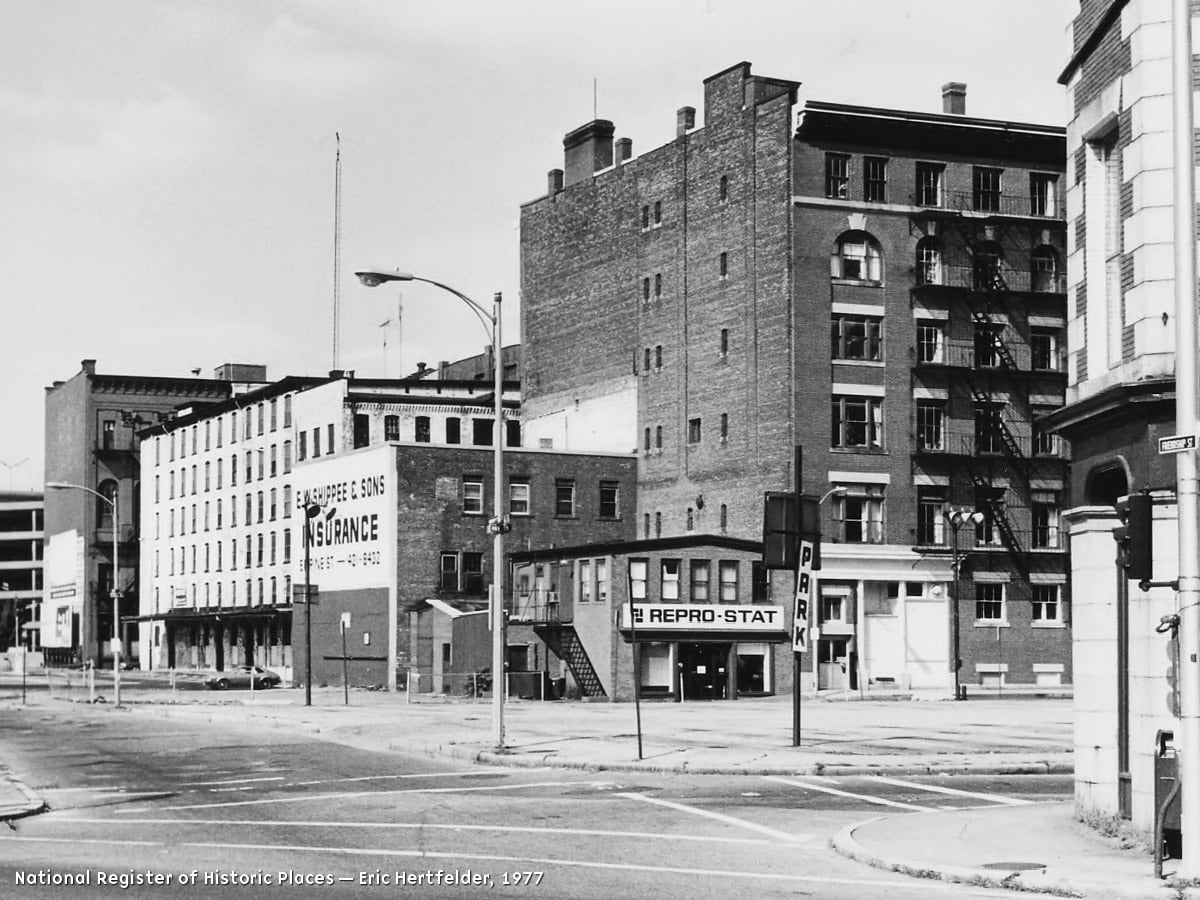
Looking west towards the northern edge of the Jewelry District. On the right is the original Hanley Building without penthouse or mural. Photo by Eric Hertfelder, National Register Nomination Form, Downtown Providence Historic District, 1977 -
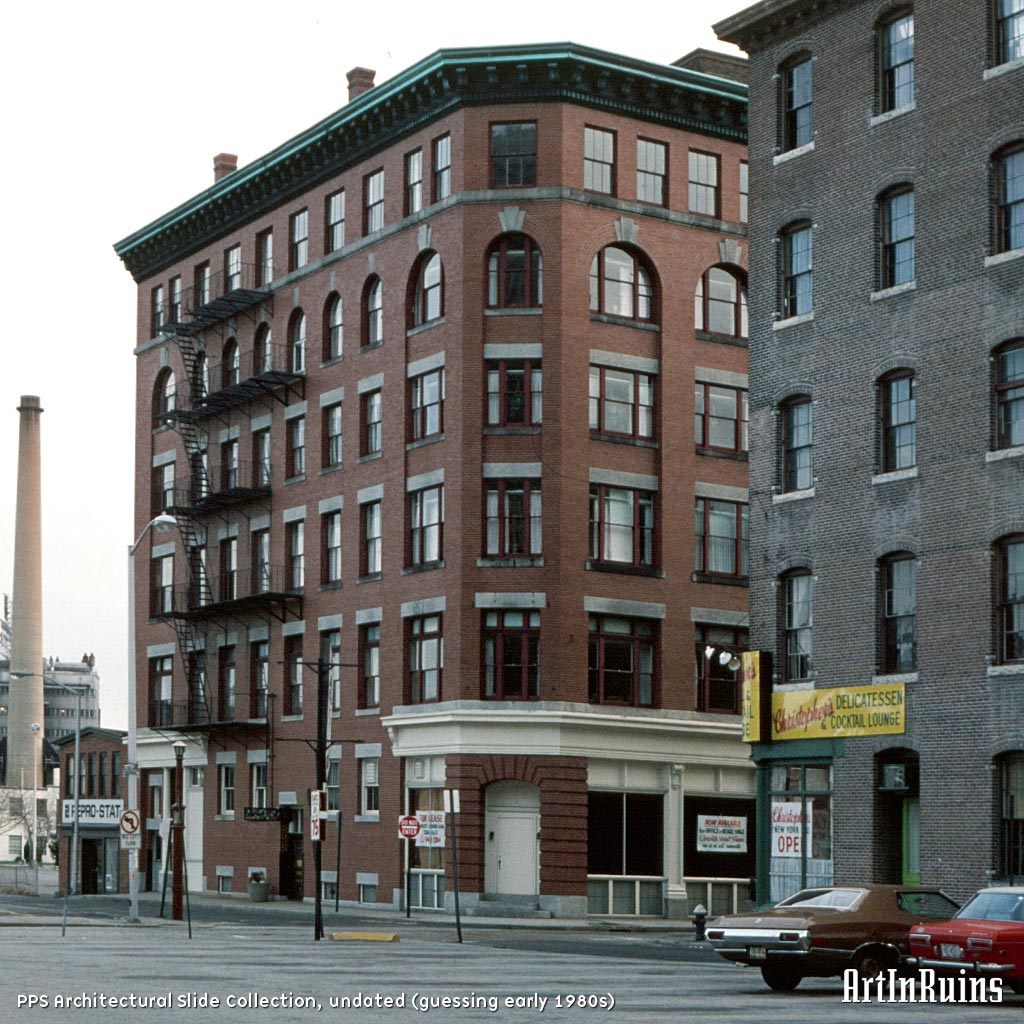
Looking southeast down Peck Street across the northern side of the building with its distinguishable chamfered corner. Undated, guessing early 1980s — PPS Architectural Slides Collection -

Looking northwest at the mural during repainting -
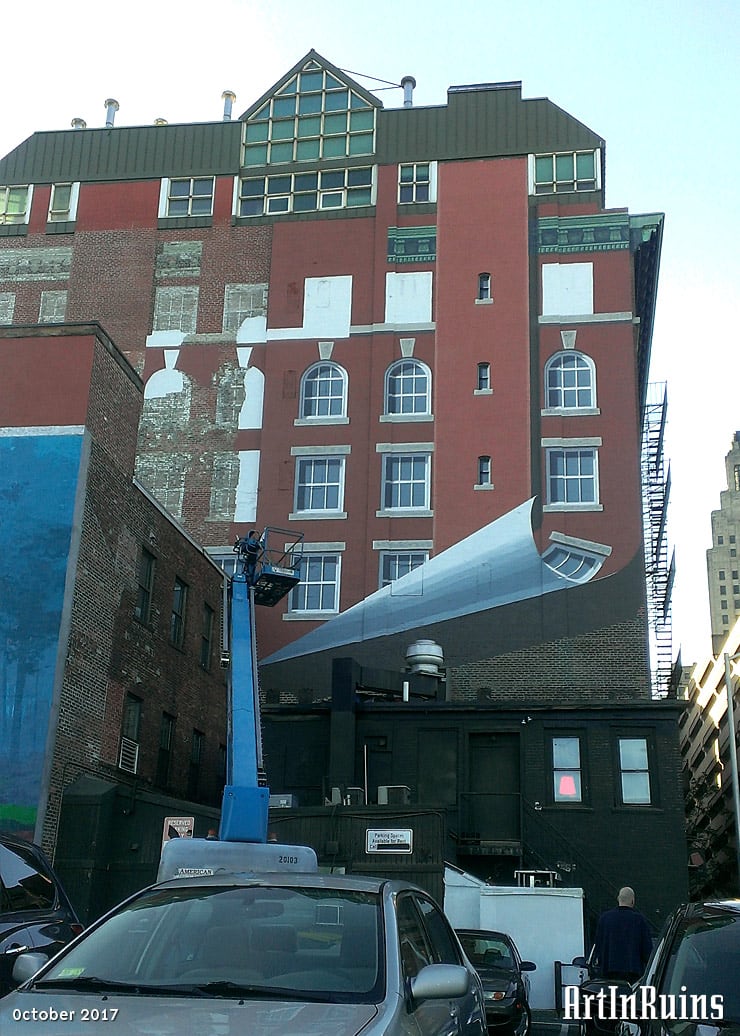
Looking northwest at the mural during repainting -
![]()
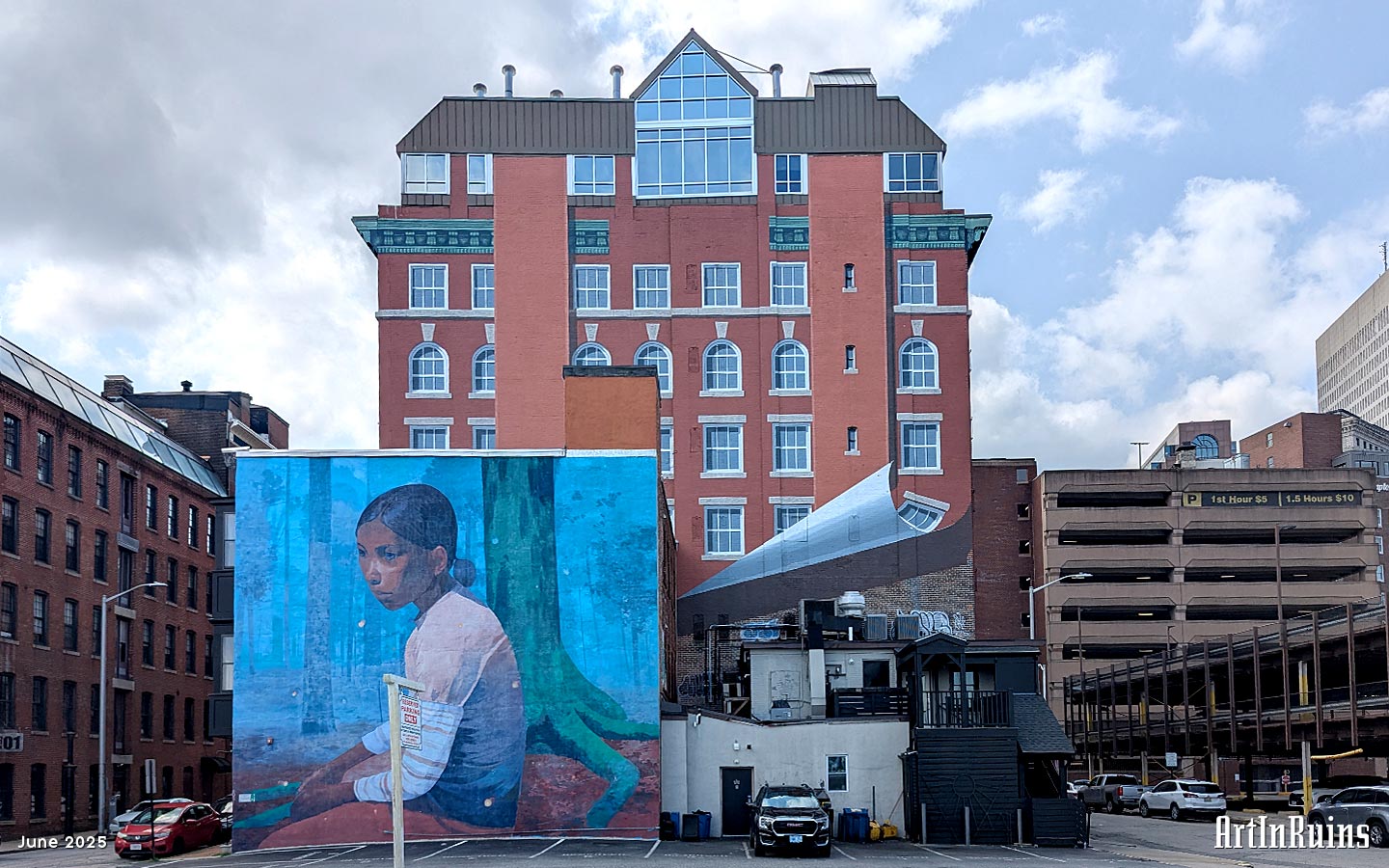
The fully restored mural a few years after its renovation -
![]()
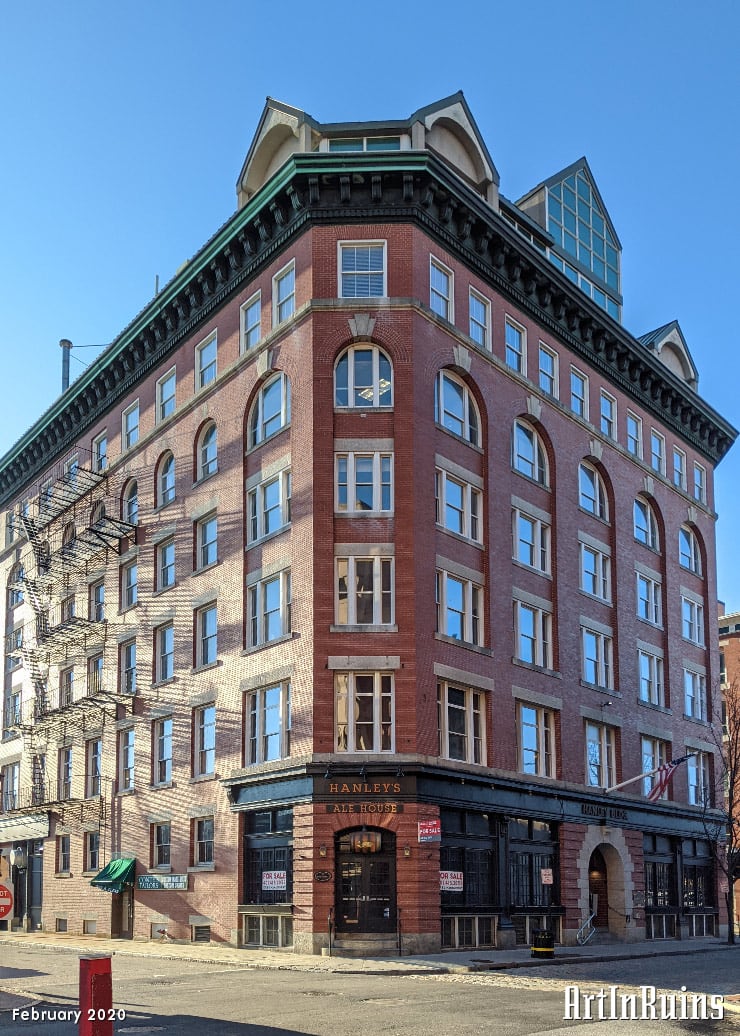
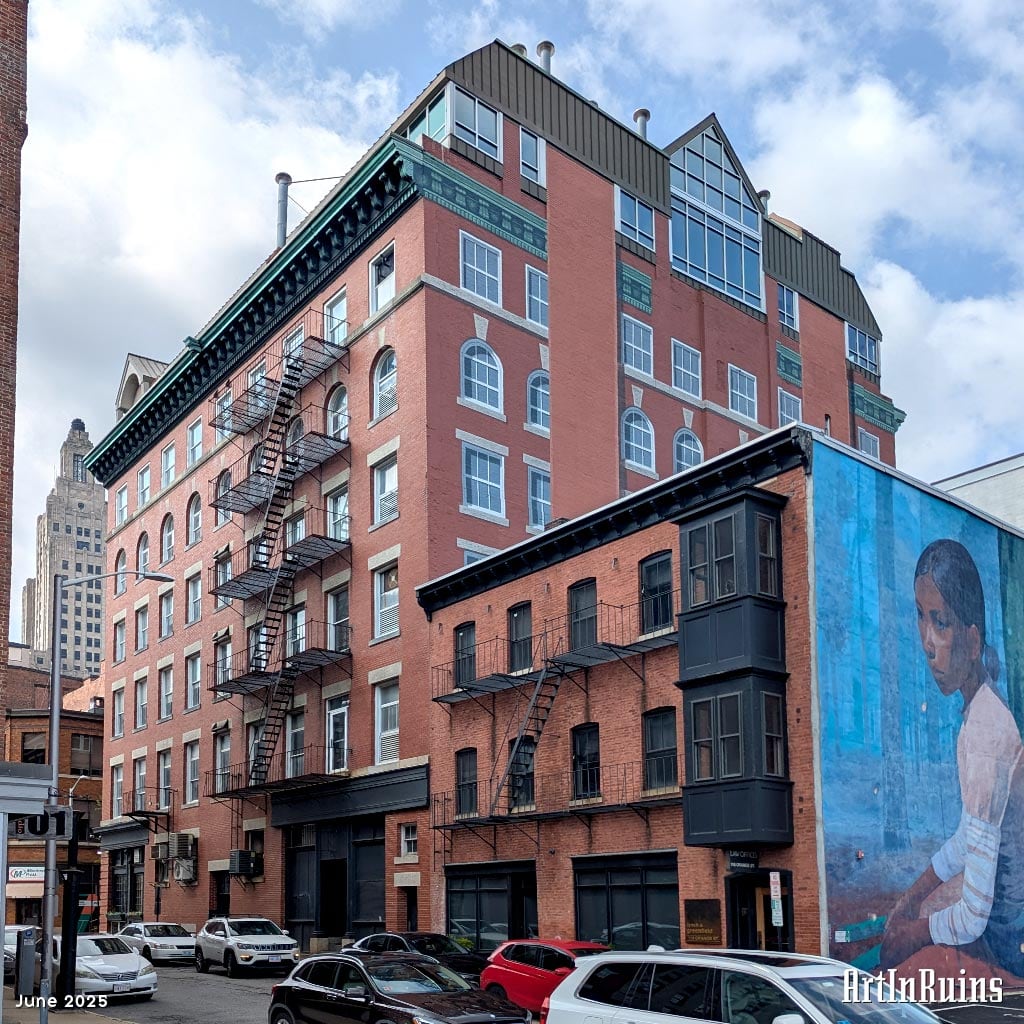
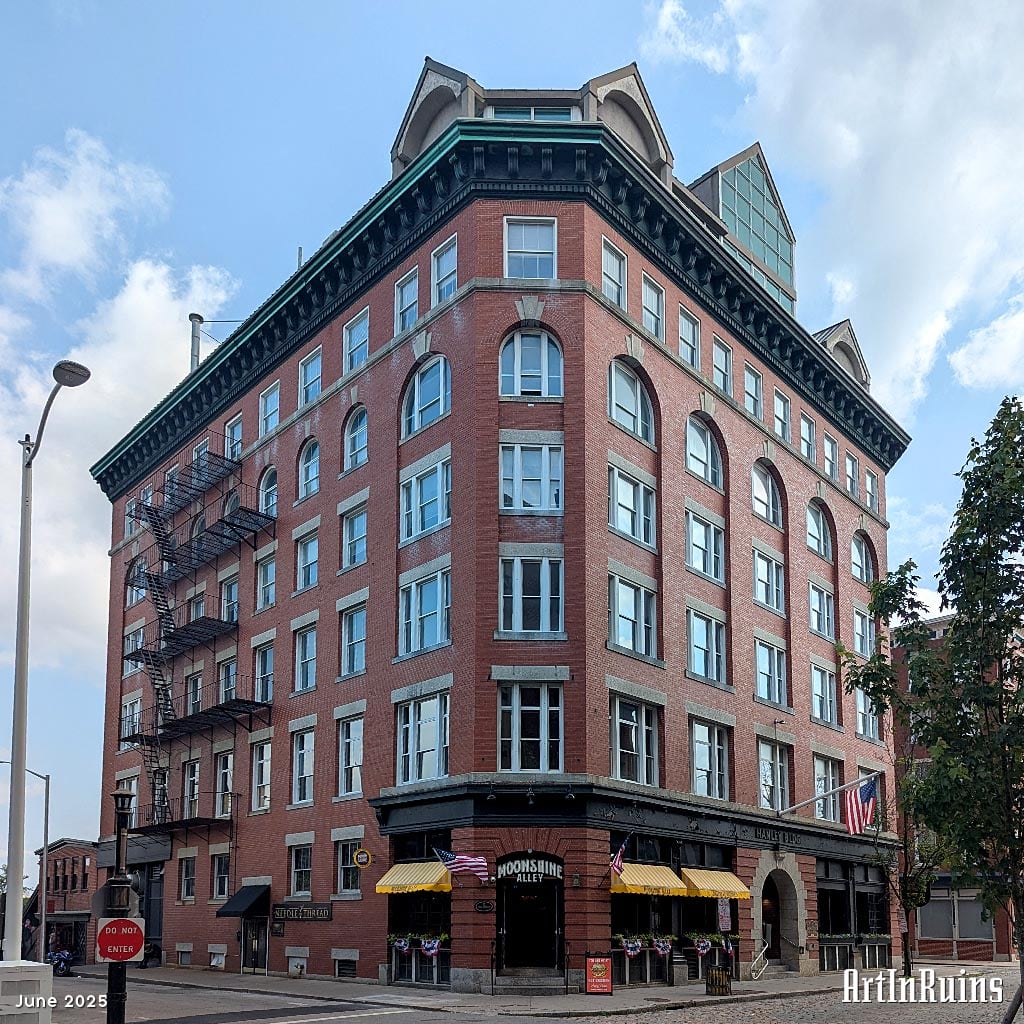
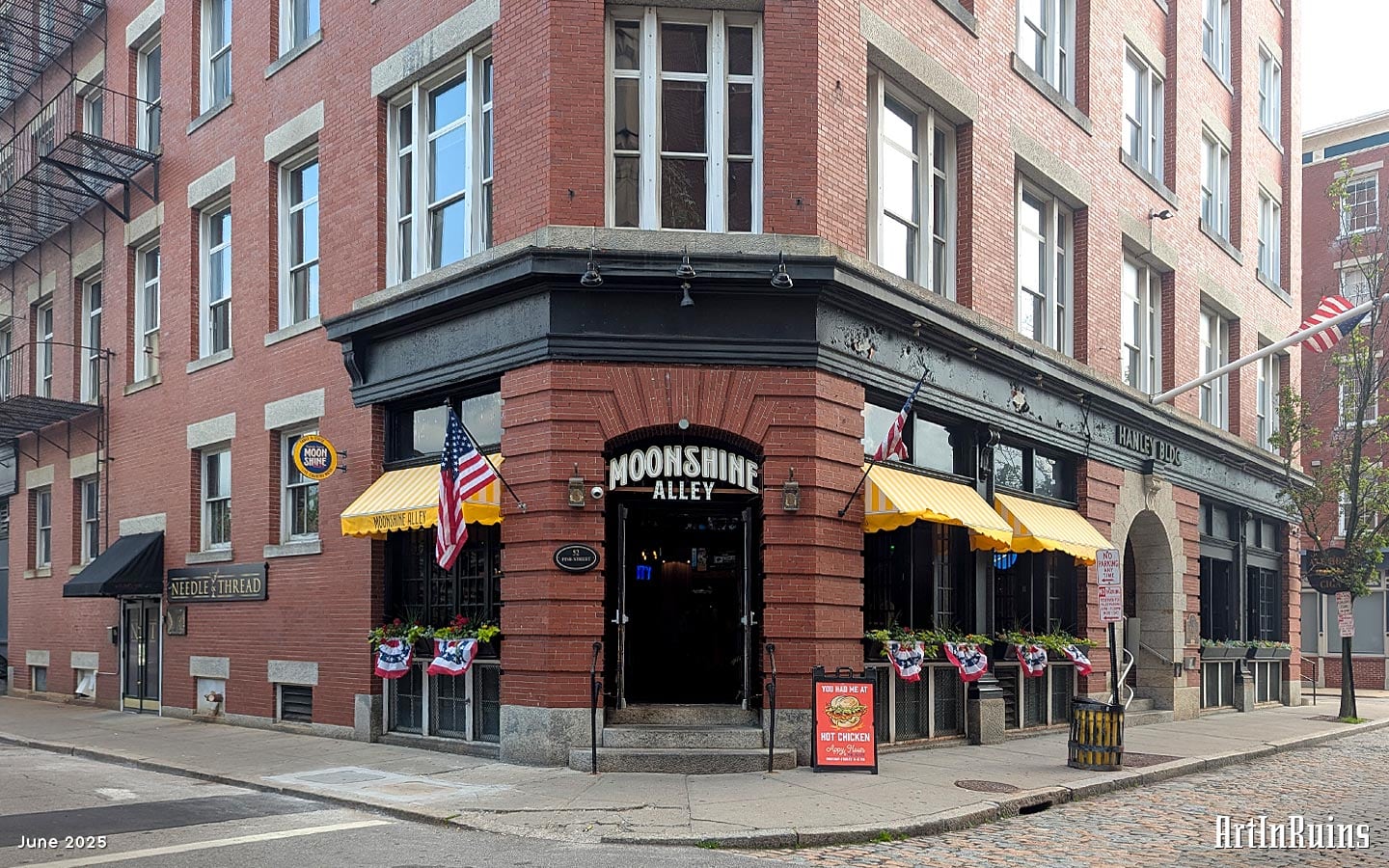
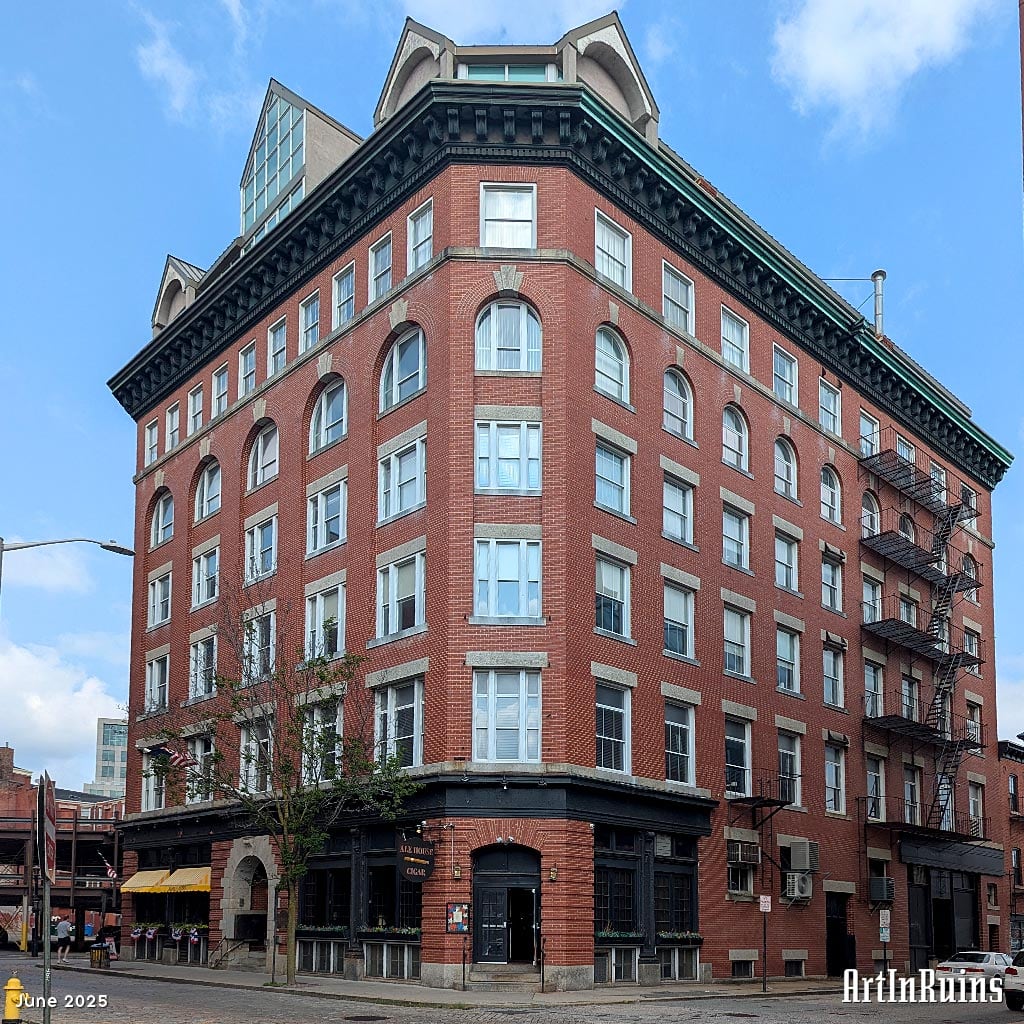
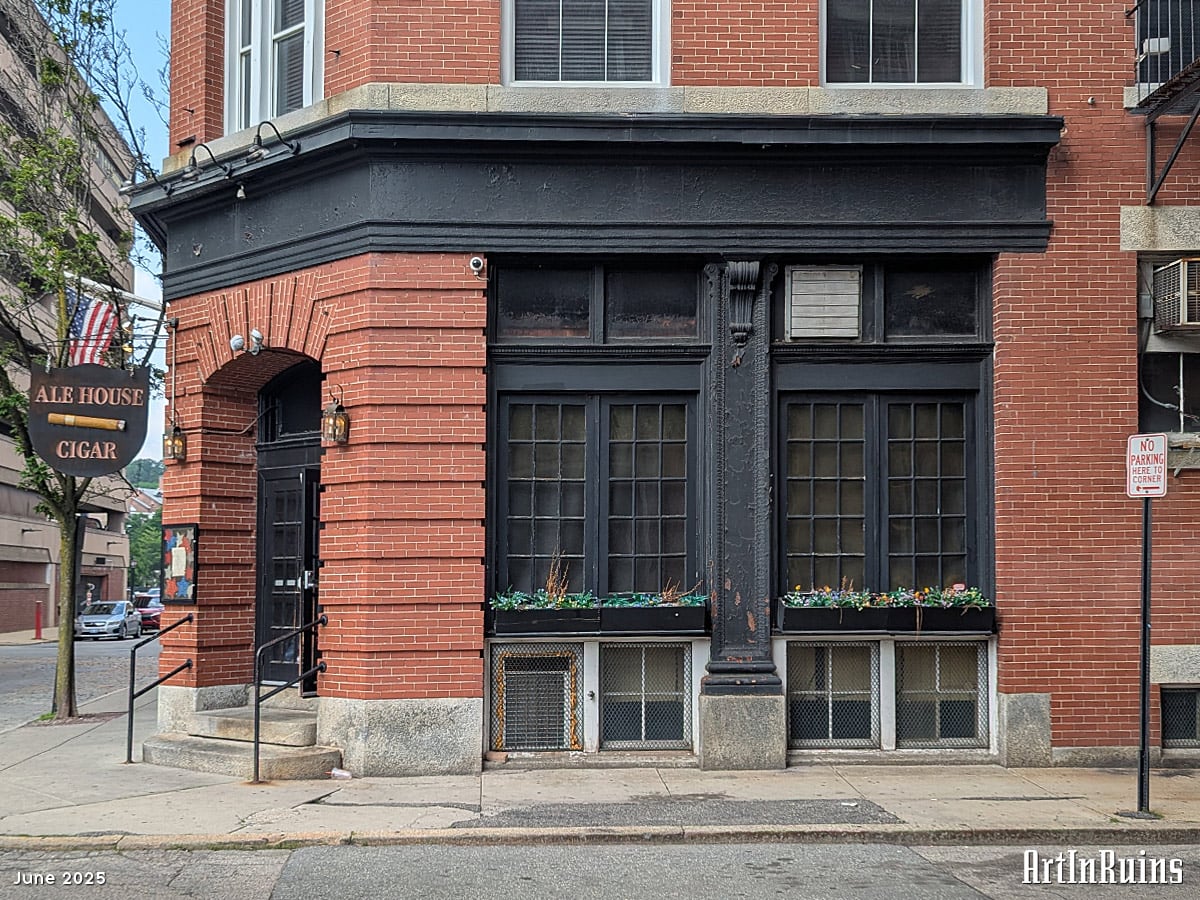
Three-quarter view of the Hanley Building in 2020 with Hanely’s Ale House in the northern corner -
![]()
-
![]()
-
![]()
-
![]()
-
![]()
-
![]()
-
![]()
-
![]()


14 images: Press to view larger or scroll sideways to see more. Contributions by Eric Hertfelder for the National Register and the PPS Architectural Slides Collection
About this Property
Redevelopment
Developer Joseph Cerilli of the Providence Land Co. bought the Hanley building in 1981 from Milton Bickford, who owned Foremost Lithograph Co.1
At the time, 2 1/2 floors were vacant and the surrounding neighborhood was in a slump. But the Garrahy Judicial Complex was under construction, and the area became more desirable for businesses. Many light industrial buildings turned over into office space. Cerilli and the Providence Land Co. also owned and managed the 1897 Masonic Temple building on Dorrance St. Cerilli was best known at the time for having rehabilitated the old Providence Journal building on the Westminster Mall, removing the flat stone façade and repairing the original details.
In 1986, Cerilli hired Johan Bjurman and Joseph Cerilli to paint a mural on the empty side of the Hanley building. Both artists worked in the “trompe l’oeil” style, which means they specialized in making objects look real. The mural continued the look of the building from other sides by painting fake windows, and in the lower right corner, an effect that makes it look as though the façade of the building is peeling up and away.
Johan Bjurman would continue to work in and around Providence for many years. He was the painter of the 25th Anniversary of AS220 mural on the back of the Pell Chaffee Performance Center in 2010, a design by Sheperd Fairey.
The painting was an investment of $18,000 by Cerilli to create something that could become a local landmark. The blank wall previously had advertisement space that collected $300 a month.
By 1988, the Hanley building was full and the roof sprouted a penthouse. Designed by architect James Barnes, the 7,000-square-foot steel and glass structure features four dormer windows, two peaked roofs and an ersatz mansard that echoes the Hay building nearby on Dyer Street. It adds 20 feet to height of the Hanley building.
Barnes designed a window system that wraps around the penthouse and offers views from every office along its outer edges. “We wanted to create an illusion, the sense of a mansard-style roof structure, but still have the glass go around as in a modern office building,” he says.
Barnes put glass-enclosed gables on the front and rear of the penthouse to give it, he says, the feeling of twin entrance ways. Inside, the gables translate into conference rooms. The penthouse is an entirely new building built atop the old one. He says anchoring the penthouse to the roof of the Hanley building was tricky, and praises the engineer, Wilbur Yoder, for developing a system that allowed construction to proceed while protecting the building from leaks.
The Hanley building was able to support the glass and steel penthouse without additional structural changes because it was originally built as a factory and warehouse. “The loads that you would need for storage are heavier than you would need for offices,” he says.2
Current Events
In 2017, the iconic mural was restored by Shawn Gilheeney and the team at Providence Painted Signs. A few of our photos captured the renovation. The building continues to offer commercial space to businesses and has a few ground-floor restaurant spots that occasionally change hands. Ten Steak and Sushi was a tenant at 55 Pine Street since 2001 until about 2015.
History
From “Downtown Providence: Statewide Historical Preservation Report P-P-5,” prepared by the RIHPHC, May 1981
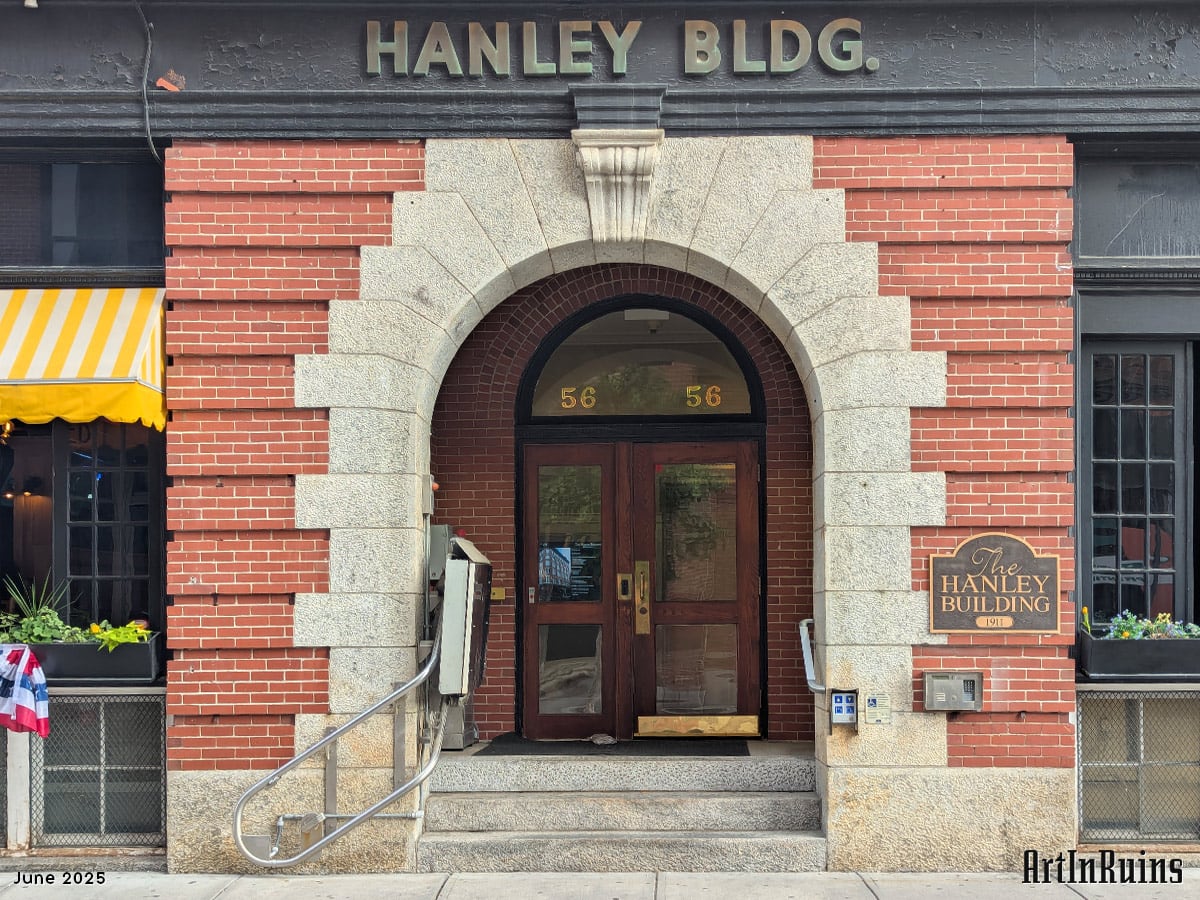
Pine St, 52–60: Hanley Building (ca. 1910): William R. Walker & Son, architects. 6-story, brick-sheathed building with truncated corners; slightly altered original wood-and-plate-glass storefronts; upper stories articulated by pier-and-spandrel system with piers culminating in round-head arches above the sixth floor; heavy classicizing boxed metal cornice. Built by James Hanley, who operated a brewery, as an investment property housing/light industry, this structure first housed a gold-leaf manufacturer, a dye-stuff company, a book-binder, a printer, and an electric supply company. It was converted to commercial space with the de-industrialization of this area in the mid-20th century.
James Hanley, 1841-1912 — Hanley’s first important step into the world of business came at the age of twenty. He opened an inn and liquor store in downtown Providence. In 1876 he began his career as a brewer in partnership with fellow-Irishman John P. Cooney. His major enterprise became known as the James Hanley Brewing Company in 1891, but he also established the Providence Brewing Company and the Hanley-Hoye Company, a wholesale liquor dealership. In addition, Hanley became a director of the National Exchange Bank and several other large financial corporations.
Hanley loved the sport of thoroughbred horseracing and became nationally prominent as the trainer and owner of fine and successful racehorses, one of which, a pacer named Prince Alert, held the world’s record for the half-mile. In his business, he used the best draught animals available and his prize teams of six, nine, and twelve horses won many national and international competitions bringing wide attention to his fine ale. Hanley’s teams (foreshadowing those of Budweiser’s August Busch) were known as the “World’s Best,” and Providence residents thrilled to the appearance of these handsome deep-chested animals in parades and other public celebrations. His most famous group was “the Big Nine,” a synchronized team of roan Belgian horses, ranging in height from 17 to 19 hands and in weight from 2,200 to 2,500 pounds. The entire entourage, weighing over ten tons, hauled a twenty-foot show wagon and was regarded as one of the world’s finest teams of draught horses.
— Excerpted from the RI Heritage Hall of Fame, visited July 11, 2025
In the News
Can you believe your eyes? Optical illusions paint a stunning face on dull architecture
by Bill Van Siclen
Providence Journal | July 29, 1988
THEY ARE THE BRAQUES OF brick and the Michelangelos of masonry. They can take a dull, drab wallflower of a building and turn it into an architectural fashion plate. Give them an open expanse of brick or stone and they’ll give you a faux facade that, from a distance at least, can’t be distinguished from the real thing.
When developer Joseph Cerilli wanted to spruce up the windowless southern face of his Hanley Building in downtown Providence, for example, he turned to local muralist Johan Bjurman of Bjurman Graphics.
Bjurman, who honed his skills as a billboard painter, specializes in what are known as trompe l’oeil murals. Trompe l’oeil, a French term meaning “fools the eye,” has been around for centuries. But increasingly it’s being used by artists and designers such as Bjurman to give new life to otherwise undistinguished walls and buildings.
For the Hanley Building mural, Bjurman and Cerilli decided to continue the window and cornice patterns on the front and sides of the building. But they also decided to add a twist - a clue to let viewers know that the visual joke was on them.
At the mural’s lower righthand corner, just above street level, Bjurman painted what looks like the edge of a King Kong-sized poster that’s slowly peeling off the side of the building.
[An alternate idea that Bjurman pitched was that he paint a version of himself painting the windows. Cerilli liked both ideas and allowed Bjurman to choose his favorite.3]
To the passing motorist or pedestrian, Bjurman’s mural, which took about three weeks to paint, looks a lot like the rest of the Hanley Building: a handsome red brick office building designed in the popular Renaissance Revival style. It’s only after one sees the peeling corner that the illusion ends and the doubletakes begin.
Doubletakes are also a common reaction to the murals of Smithfield artist Bill Perry. Perry, who’s a commercial artist by training, has painted outdoor murals for the City of Woonsocket, Woonsocket Call and the General Electric plant in Lynn, Mass.
His first local commission came in 1979, when he won a statewide contest to design a mural for the back of Woonsocket City Hall.
His proposal called for a trompe l’oeil version of the Slocum Building (see Lifebeat cover), a red brick structure that had stood next to City Hall for many years, but which was torn down in 1970. The mural would reunite the two buildings, if only in the realm of art and illusion.
Working from old photographs, Perry and a crew of sign and billboard painters spent almost a month creating an architecturally correct and visually convincing portrait of the Slocum Building (which once housed McCarthy’s Department Store, a Woonsocket landmark).
“It was like a large scale version of paint-by-numbers,” Perry said over the phone this week. “The only problem is getting the proportions right, and even that isn’t very difficult once you know what you’re doing.”
Bjurman and Cerilli, meanwhile, teamed up on another project last year. To lure buyers for an yet to be built condominium development on India Street in Providence, Cerilli asked Bjurman to decorate the facade of his sales office so that it would look like the proposed condominiums (see Lifebeat cover).
The result is a marvelous bit of trompe l’oeil decoration that not only makes good business sense, but adds a touch of artistic panache to the Providence waterfront.
— SICLEN, BILL VAN. “Can you believe your eyes? Optical illusions paint a stunning face on dull architecture.” Providence Journal (RI), ALL ed., sec. LIFEBEAT/WEEKEND, 29 July 1988, pp. D-01. NewsBank: America’s News, https://infoweb.newsbank.com/apps/news/openurl?ctx_ver=z39.88-2004&rft_id=info%3Asid/infoweb.newsbank.com&svc_dat=NewsBank&req_dat=D4BD6B42F1AB4706B5E1244D477DEE03&rft_val_format=info%3Aofi/fmt%3Akev%3Amtx%3Actx&rft_dat=document_id%3Anews/1525262E12B1F320. Accessed 12 July 2025.
-
HOPKINS, LORRAINE. “Drab wall of Pine St. building converted by billboard artist to an eye-catching deception.” Providence Journal (RI), CITY ed., sec. CITY LIFE, 24 Dec. 1986, pp. 0-01. NewsBank: America’s News, https://infoweb.newsbank.com/apps/news/openurl?ctx_ver=z39.88-2004&rft_id=info%3Asid/infoweb.newsbank.com&svc_dat=NewsBank&req_dat=D4BD6B42F1AB4706B5E1244D477DEE03&rft_val_format=info%3Aofi/fmt%3Akev%3Amtx%3Actx&rft_dat=document_id%3Anews/15252CEACEEE5F58. Accessed 13 July 2025. ↩
-
Excerpted, reordered, and partially rewritten with some additions from the following article: CASTELLUCCI, JOHN. “Hanley building blooms, penthouse attracts tenant.” Providence Journal (RI), CITY FINAL ed., sec. NEWS, 30 Dec. 1988, pp. D-01. NewsBank: America’s News, https://infoweb.newsbank.com/apps/news/openurl?ctx_ver=z39.88-2004&rft_id=info%3Asid/infoweb.newsbank.com&svc_dat=NewsBank&req_dat=D4BD6B42F1AB4706B5E1244D477DEE03&rft_val_format=info%3Aofi/fmt%3Akev%3Amtx%3Actx&rft_dat=document_id%3Anews/152527778E9EBCA0. Accessed 12 July 2025. ↩
-
“Drab wall of Pine St. building converted by billboard artist…” ↩