Elizabeth Building
also known as Goldsmith-Tregar Company Advertising, New England Financial Group
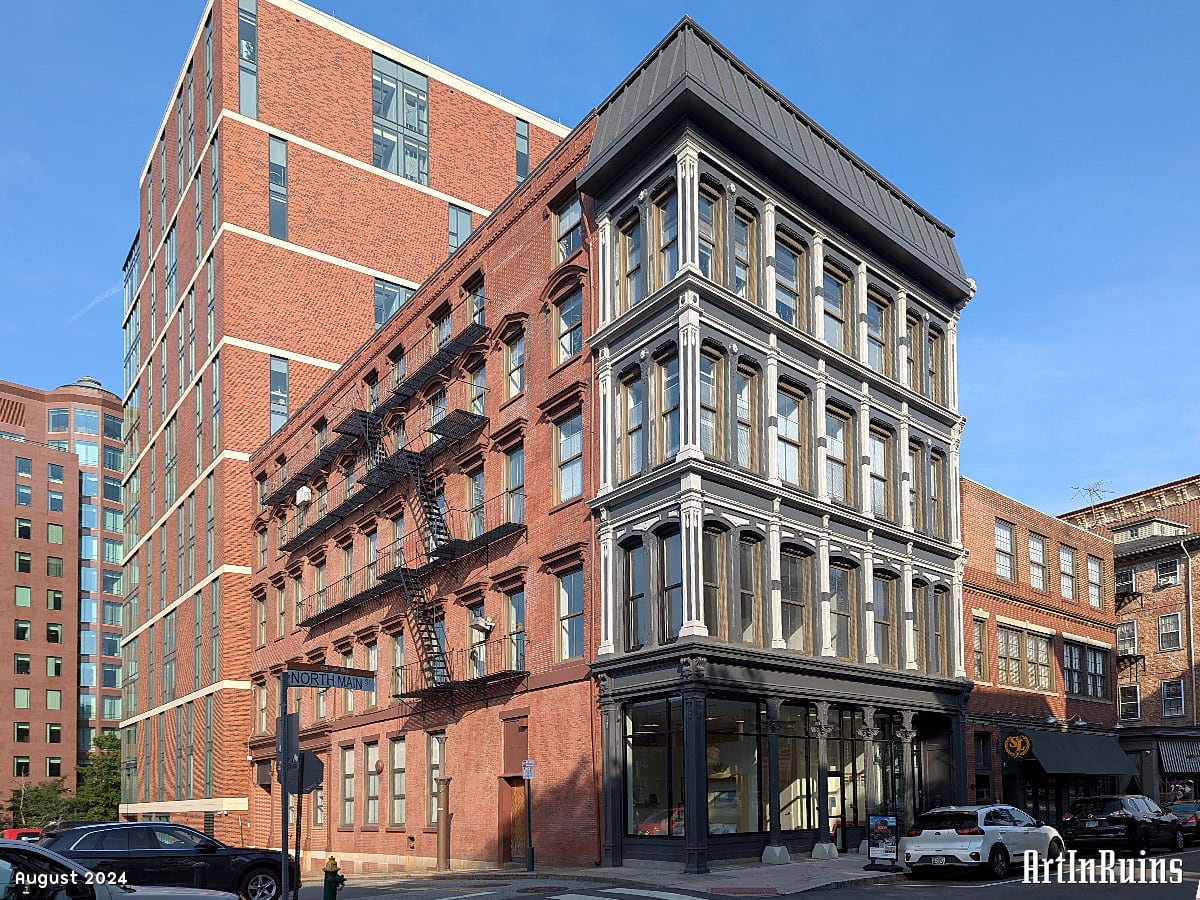
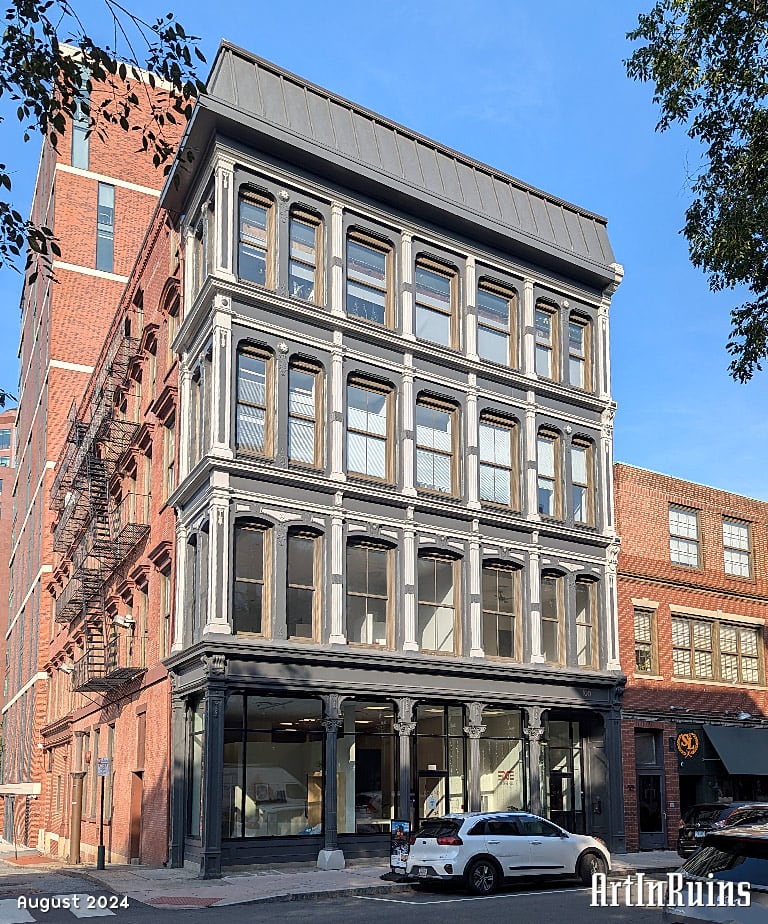
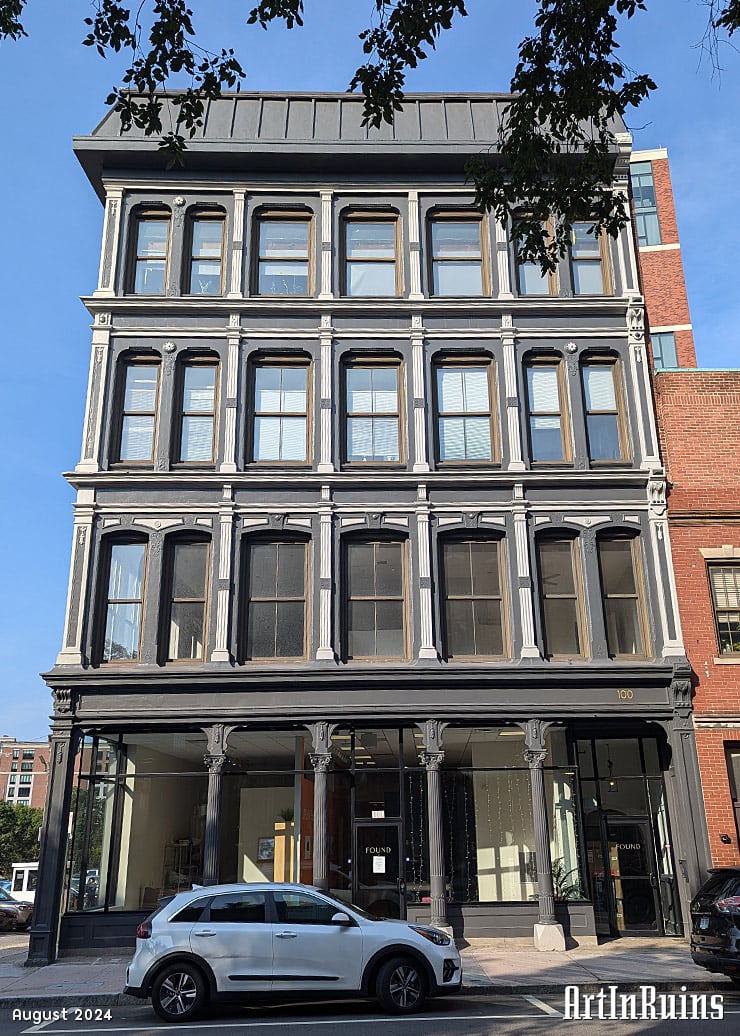
A five-story late 19th-century commercial building with one of the few cast iron façades in the city
images of this Property
-
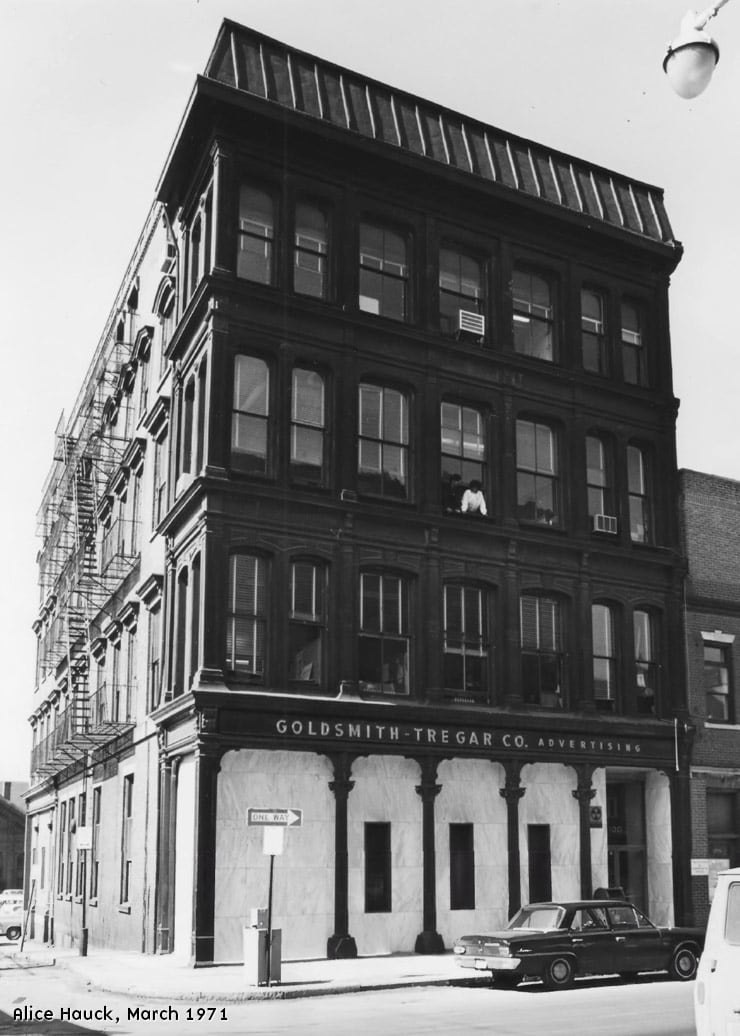
Exterior seen from the southeast. Photo by Alice Hauck for the National Register, March 1971 -
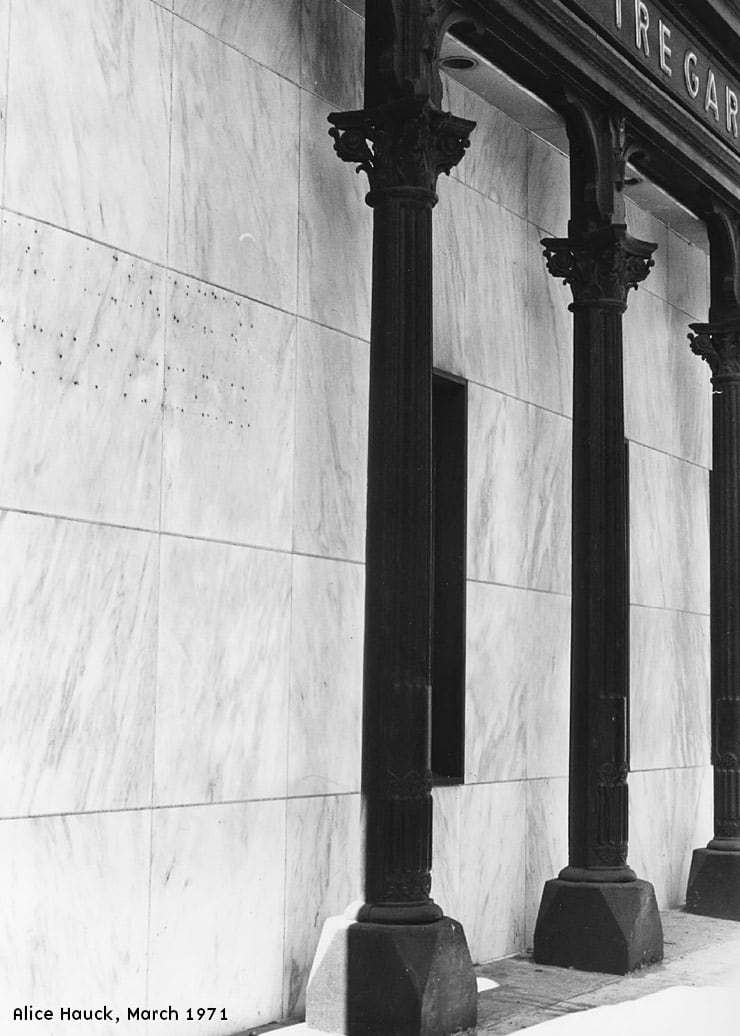
Cast iron columns at street-level supporting the iron façade; the marble screen behind them is a very recent insertion. Photo by Alice Hauck for the National Register, March 1971 -
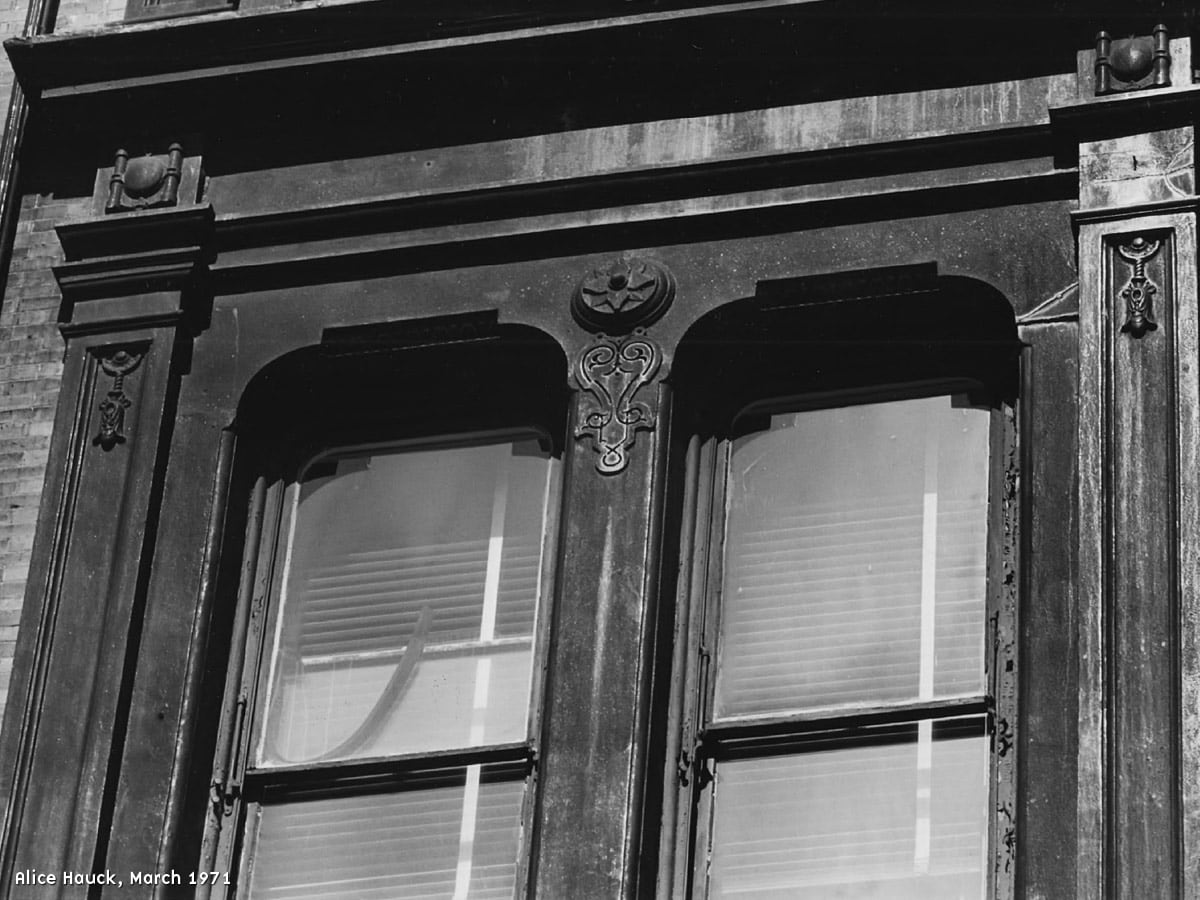
Detail of iron structure and ornament on east façade. Photo by Alice Hauck for the National Register, March 1971 -
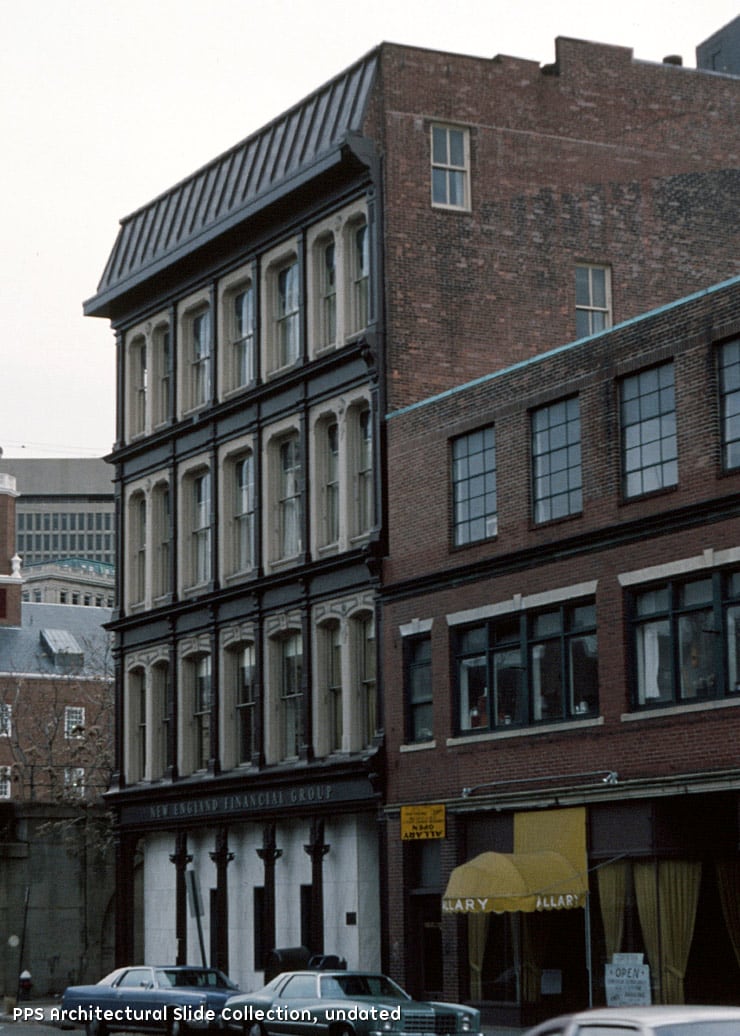
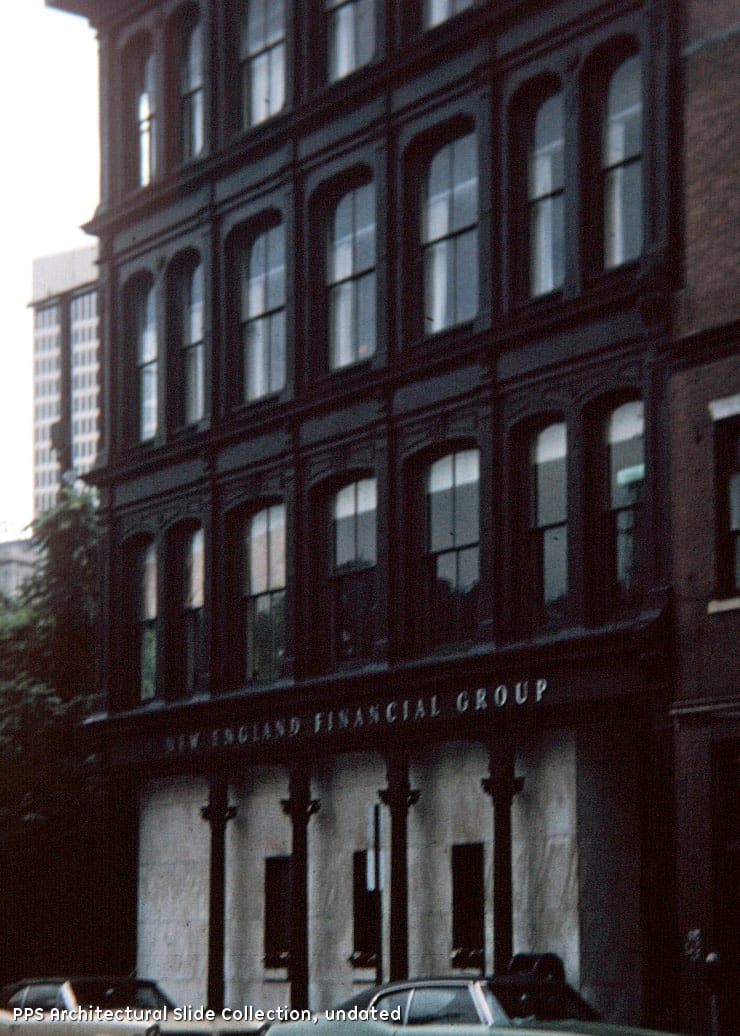
Undated — PPS Architectural Slides Collection -
![]()
Since the previous photo, the window bays have been painted. Or, this photo came first and the previous photo was a restoration and paint removal. Undated — PPS Architectural Slides Collection -
![]()
-
![]()
-
![]()
-
![]()
-
![]()
10 images: Press to view larger or scroll sideways to see more. Contributions from the PPS Architectural Slides Collection
About this Property
Development
A building such as this, so close to the seat of state government, has been involved in local politics insofar as it has been home to many state offices. We found references in newspaper stories to state office leases as early as 1899. Other stories mention official business meetings occurring in the building such as the State Board of Charities and Corrections, the Officer’s Rifle Association, The State Brigade, and the State Board of Education.
The building was commissioned from Alfred Stone before he became part of Stone & Carpenter by Rufus Waterman (II). According to Richard Waterman from a news story in 1987, it was named for Elizabeth Waterman born 1777. She was the second of 13 children of Rufus Waterman (I) and Hannah Sprague, which would have made her Rufus Waterman’s (II) aunt, who would have recently died only two years before construction began.
Far be it from us to say that Richard Waterman is wrong. It can very well be that the Rufus Waterman (1817–1896) alive during 1871, when this building was constructed, named it for his aunt. The family is full of Elizabeths, Rufuses, and Richards:
- Rufus Waterman (I) (1746–1829) married Hannah Sprague (c. 1752-1833)1
- 13 children; Sarah, Elizabeth, Henry, Nathan, Mary, etc.
- Daughter Elizabeth “Eliza” (1777-1870) had no children
- Henry Waterman (1791–1821) married Sarah Thurber (1795–1872)2
- Two children, Rufus (1817–1896) and Marcelia (1821–1894)
- Rufus Waterman (II) (1817–1896) married Elizabeth Bowen Greene (1818–1848) in 1838
- Children; Richard (1841–1900), Mary Cooke (1842–1845), Lt. Rufus Jr. (III) (1844–1904), Anna Bowen (1846–1887), and Edward Thurber (1848–1848). Elizabeth died in childbirth to Edward at age 30.
- Rufus then marries Elizabeth’s sister, Emily Greene (1825–1883) who had no children.
It could also be that Rufus the II named the building in memory of his wife who died in childbirth. To us, it is quite possible that the street was named for Elizabeth “Eliza” Waterman (1777–1870) while the building was named for Elizabeth Bowen Greene Waterman (1818–1840). The biggest plot hole is that she died in 1848 and construction started on the building in 1872, 24 years later. That’s a long time to wait to memorialize someone.
Consider as well that David Brussat has the same theory as we do:
His first was the Elizabeth Building, at 100 North Main St., a brick Second Empire designed by Stone & Carpenter and built by Rufus Waterman, who named it for his wife.3
So again, Richard Waterman knows his family best. It just gets very confusing with all these Rufuses and Elizabeths. Maybe Rufus named the building in honor of all the Elizabeths in the family.
Current Events
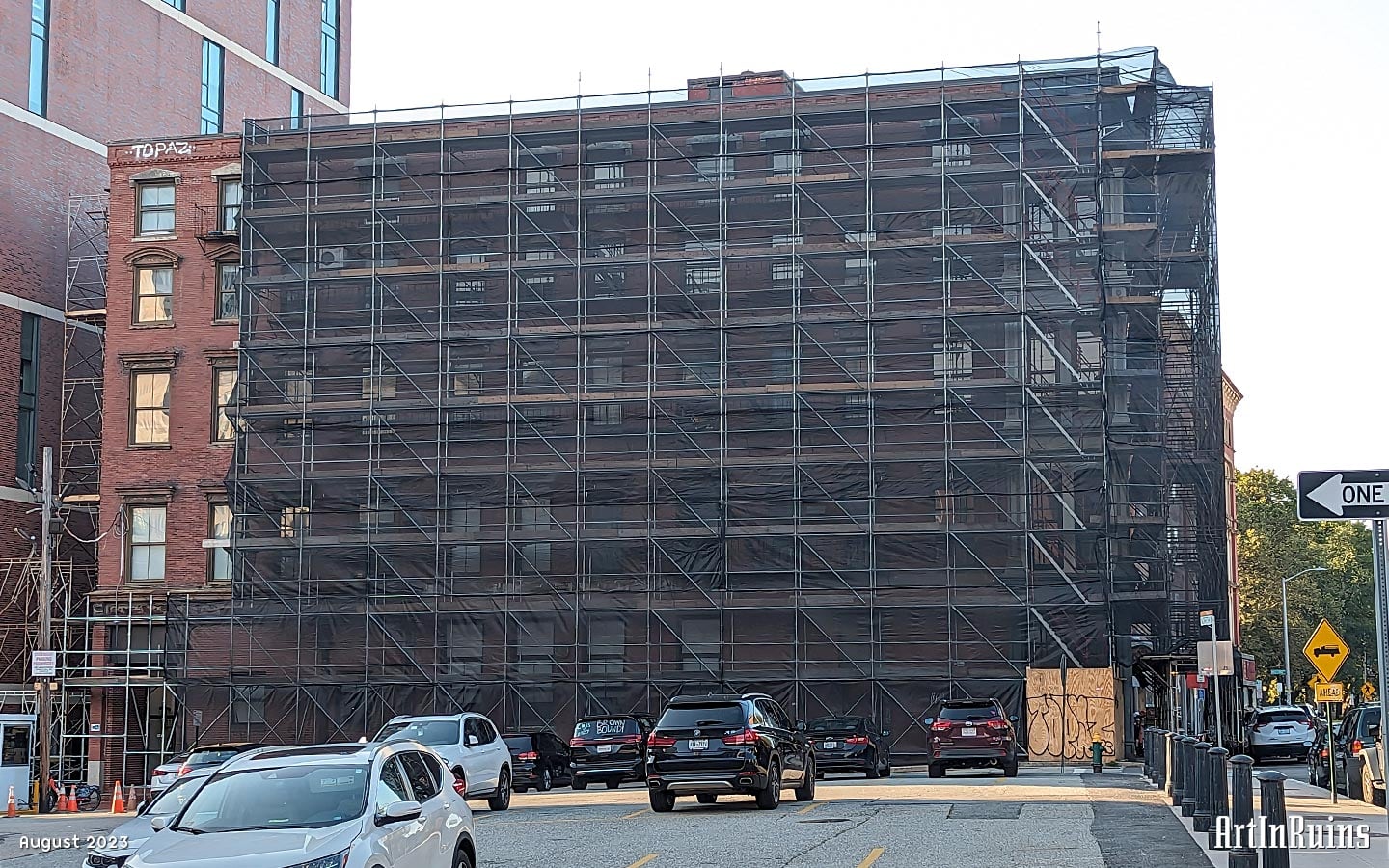
The building underwent renovation around 2007 and again around 2023. In 2007, the marble façade along the street front units was removed. It is a mix of commercial and office space.
History
From “Providence: A Citywide Survey of Historic Resources,” prepared by the RIHPHC, 1986
(Excerpted from page 115) Use of cast iron as an integral component of the office building had begun in New York in the 184Os. In these buildings, iron was used in columns for internal support and on exterior wall surfaces. Structural cast iron had appeared in Providence by the mid-1850s used as a secondary material, in the Custom House. The development of the metal structural system in Providence did not parallel that appearing elsewhere. The steel-frame structural system was not developed until after the Civil War since one of its chief advantages — enabling greater height — was of less importance in Providence than elsewhere. The city’s first commercial building with an iron front, the Lyceum Building, was erected in 1858 (demolished 1926). Several iron-front buildings were constructed here in the 1870s, including the Equitable Building (1872; Walker & Gould, architects), 36 Weybosset Street, and the Elizabeth Building (1872; Alfred Stone, architect), 100 North Main Street. The pace of construction diminished following the Panic of 1873, and by the time it resumed in the late 1870s, cast-iron facades had passed from fashion.
From the College Hill Historic District nomination form, Edward F. Sanderson & Keith N. Morgan, January 1976
Elizabeth Building, 1874-6. Second Empire: 4 stories; brick structure with cast iron facade; mansard roof; iron Corinthian columns in front of modern marble wall on first floor; run of segmental topped windows in iron frame for top three floors.
From the National Register Nomination Form, November 1971
Completed by 1876, the Elizabeth Building was part of a boom in the contraction of commercial building in Providence during the 1870’s and 1880’s. (As this building is first mentioned in the Providence business directory of 1876, it is logical to conclude that it was erected in 1875 or 1874–1875 and — although the architect has not been identified — that it was designed by one of the twenty-one local architects or firms listed in the l874 directory.) At this time such cast-iron structures as the Equitable Building, by Walker and Gould, and the Hoppin Homestead Building, by James Bucklin, were also being erected here. These Providence “cast-iron fronts” were of four storeys only, in contrast to the higher structures of the same type seen in Mew York City.
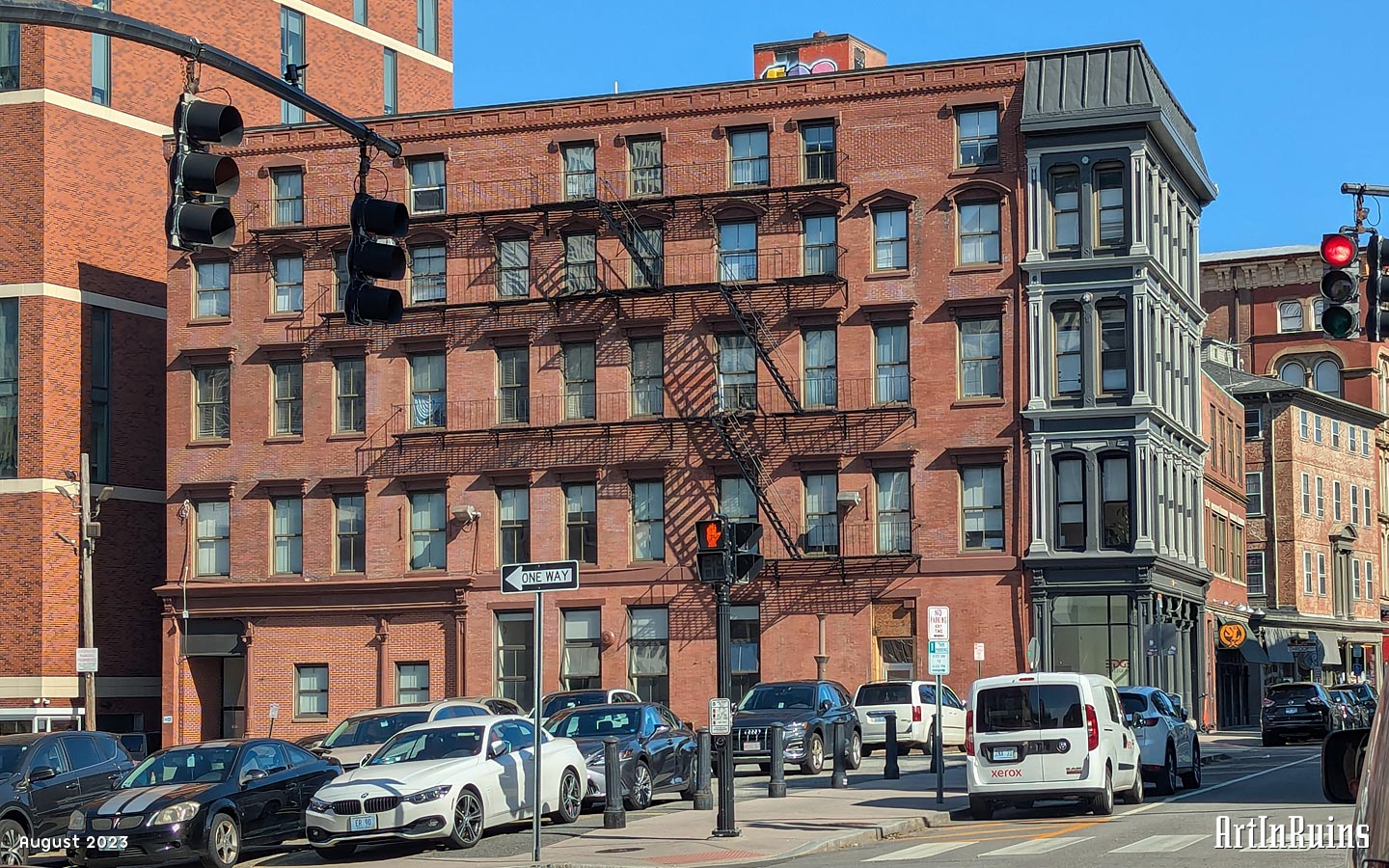
The black-painted cast-iron front of the Elizabeth Building not only forms the main (east) street façade but also wraps around a two-bay section of the south side of the slender but massive rectangular structure (otherwise brick-walled), extending the ornamental detailing around an angle viewed from approaching streets. An 1891 photograph of the building shows the upper storeys of the iron front minted in a light colour, no doubt imitating stone, as such ironwork was intended to imitate. While the cast-iron cast façade is divided into four storeys, the building actually contains five storeys, as the brick side and rear elevations reveal. The fifth floor is masked on the east elevation by a windowless mansard roof with ribbed metal covering.
Each floor of the iron front is divided from the next by a deep entablature with brackets in the frieze. These frieze brackets connec the vertical impetus begun at the base by the (now free-standing) fluted Corinthian columns with the Doric pilasters of the upper floors. A central accent is created by the groupings of the façades five bays: the three middle bays are set between a wider bay at each end. At first-floor level the end bays both originally contained entrances (at present, there is only one, in the north bay). On the upper floors the three central bays each contain one window; the end bays contain paired window openings. On each floor these bays are separated by four fluted Doric pilasters into a configuration of aa-b-b-b-aa. The angles of the building are marked by panelled Doric pilasters at each floor level: the upper portions of their panels contain stylised floral ornament. The plain brick back and side walls of the building are pierced by a variety of window arrangements with strongly projecting and varied cast-iron cappings.
The interior of this building is of extremely simple plan. Directly inside the north, street-level entrance is a hall which contains an iron staircase and an elevator. Offices now fill the rest of this floor, doubtless originally devoted to shop space. Upper floors contain, as always, variously subdivided office space.
Alterations on the exterior are minor. The original glazed shopfronts of the ground floor were in I960 replaced by Philemon Sturges with a marble curtain wall recessed behind the stone-based iron Corinthian columns and corner piers. A section of cornice on the north side is missing; a columned store-front at the south-east has been filled in with brick. These changes, however, do not interfere with the over-all form and ornament of the Elizabeth Building or with its architectural integrity.
Information has been received that the cast-iron structural and decorative elements of the Elizabeth Building were produced in Providence by the Builders Iron Foundry (still existing under the name of B. I. F. Industries).
In the News
Providence sampler fetches $192,500 A Colonial girl embroidered a subtly detailed ‘rare gem’
by Elizabeth Rau
Providence Journal | March 20, 1987 (abridged)
It is “so delightful, so utterly delightful” that Marguerite Riordan cannot resist examining the 200-year-old sampler again and again to discern new details.
A frolicking shepherdess. A deer and a dancing couple. A crow and a cat. A squirrel wedged between the branches of a pear tree. Two blue urns.
“It’s a rare gem,’ said Riordan, a Stonington antiques dealer who recently bought it for $192,500 — a world record for any sampler, according to Sotheby’s auction house in New York.
“You look at it,” said Riordan, “and it lights up.”
The 12-by-14-inch sampler was embroidered in 1788 by an 11-year-old girl named Eliza Waterman while she was a student at the Mary Balch School of Providence, a boarding and day school that became known for the brilliant needlework of its students.
It was handed down through six generations of Watermans, a prominent Rhode Island family that came to Providence in 1636 from Bristol, England. Richard Waterman, the great-great-great-great-nephew of Eliza, can trace in meticulous detail the sampler’s journey:
Eliza bequeathed the sampler in 1870 to her brother’s son, Rufus Waterman II, who bequeathed it in 1896 to his son, Rufus Waterman III, who bequeathed it in 1904 to his daughter, Emily Green Waterman, who bequeathed it in 1951 to her nephew, George H. Waterman, who bequeathed it last November to his six children, the youngest of whom is Richard.
The family decided to sell the sampler to pay for the college education of their six children.
Its new owner, Riordan, a former jewelry designer from New York City, bought it at an auction in January at Sotheby’s. She has been dealing in American antiques for 25 years. She has a passion for American needlework simply because it had been neglected for years as an art form.
“These were women artists with a needle,” said Riordan. […]
But the recent purchase — still encased in its original frame and glass — is Riordan’s prize possession. She has other samplers adorning the walls of her three-story home and gallery overlooking Long Island Sound, but she said they don’t have the same panache as Eliza’s.
Riordan calls the other samplers “boring” — they usually include the alphabet, a pot of flowers or two, and some pithy ditty such as: “Virtue should be our guide.”
Eliza’s sampler is delightfully whimsical — the 1762 State House on North Main Street in Providence is framed by flowers and flying birds, women are wearing floppy white hats with plumes, a horse is tied to a blue balustrade. All nine figures have human hair and the background is embroidered in a cream-colored silk.
Unlike most other samplers of the 18th century, the linen does not show through, making Eliza’s work seem almost like an oil painting.
Eliza - a nickname for Elizabeth - was born in Providence on April 25, 1777, the second of 13 children of Rufus Waterman and Hannah Sprague. She never married, and died on July 27, l870, at the age of 93. Elizabeth Street and the Elizabeth Building at 100 N. Main St. in Providence were named for her, according to Richard Waterman.
Like most young girls during 18th century America, Eliza was expected to master needlework, a tradition carried from England by the colonists. “There was a great deal of money after the Revolution,” Riordan said. “This is just what women did if they were from a rich family.”
What kind of person was Eliza?
Riordan said she was disciplined — she said she believes it took one to two years to complete the sampler — skillful with a needle and had a playful sense of humor. She probably played the harpsichord and read the Bible daily, as did other girls at the boarding school. Undoubtedly, she had a great love for Rhode Island.
“And a love for life,” said Richard Waterman. “I’m sure she was an extraordinary woman.”
— RAU, ELIZABETH. “Colonial sampler: ‘Delightful,’ and worth $192,000.” Providence Journal (RI), ALL ed., sec. NEWS, 20 Mar. 1987, pp. A-01. NewsBank: America’s News – Historical and Current, https://infoweb.newsbank.com/apps/news/openurl?ctx_ver=z39.88-2004&rft_id=info%3Asid/infoweb.newsbank.com&svc_dat=AMNEWS&req_dat=D4BD6B42F1AB4706B5E1244D477DEE03&rft_val_format=info%3Aofi/fmt%3Akev%3Amtx%3Actx&rft_dat=document_id%3Anews/152529FDD7B80D50. Accessed 17 May 2026.
-
“Rare Needlework Sampler, Sarah Waterman, Providence, Rhode Island, dated 1785.” Sotheby’s, accessed 17 May 2026 from https://www.sothebys.com/en/auctions/ecatalogue/2012/important-american-schoolgirl-embroideries-the-landmark-collection-of-betty-ring-n08832/lot.582.html ↩
-
“Rufus Waterman (1817–1896).” FindAGrave.com, accessed 17 May 2026 from https://www.findagrave.com/memorial/21399560/rufus-waterman ↩
-
BRUSSAT, DAVID. “COMMENTARY - Downtown beauty’s rich uncle.” Providence Journal (RI), All ed., sec. Editorial, 31 July 2008, pp. B-05. NewsBank: America’s News – Historical and Current, https://infoweb.newsbank.com/apps/news/openurl?ctx_ver=z39.88-2004&rft_id=info%3Asid/infoweb.newsbank.com&svc_dat=AMNEWS&req_dat=D4BD6B42F1AB4706B5E1244D477DEE03&rft_val_format=info%3Aofi/fmt%3Akev%3Amtx%3Actx&rft_dat=document_id%3Anews/152424F4CC54E028. Accessed 17 May 2026. ↩